
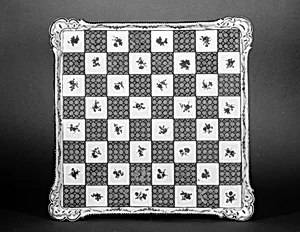
Chessboard
mid-18th century
Medium
Hard-paste porcelain
Dimensions
Overall: 14 1/4 × 14 1/4 in. (36.2 × 36.2 cm)
Classification
Ceramics-Porcelain|Chess Sets
Culture
German, Meissen
Department
European Sculpture and Decorative Arts
Museum
Metropolitan Museum of Art, New York, NY
Credit
Pfeiffer Fund, 1966
Accession Number
66.26
Rights
Public Domain
Tags
Art Historical Context
Step into the opulent world of 18th-century European aristocracy with the *Chessboard* from the Meissen Manufactory, crafted in the mid-1700s. This exquisite hard-paste porcelain square, measuring 14¼ × 14¼ inches, exemplifies the German factory's mastery of a material that revolutionized ceramics. Meissen, established in 1710 near Dresden, was Europe's first to produce true hard-paste porcelain—a durable, translucent formula long guarded by Chinese artisans—allowing for intricate modeling and vibrant polychrome enamels. Artistically, the chessboard reflects the rococo style's playful elegance, likely adorned with delicate moldings, gilded edges, or figural motifs typical of Meissen's output. As part of a luxury chess set, it transformed a strategic game into a status symbol for nobility, blending functionality with lavish decoration. Porcelain's fragility heightened its prestige, demanding skilled firing techniques to achieve flawless vitrification. Housed in the Metropolitan Museum of Art's European Sculpture and Decorative Arts department (Pfeiffer Fund, 1966), this piece captures Meissen's cultural dominance in the decorative arts, fueling Europe's obsession with porcelain "white gold." Imagine royals pondering moves amid such finery— a testament to art's power to elevate everyday leisure.
About the Artist
Meissen Manufactory · 1710–present
The Meissen Manufactory, established on June 6, 1710, by Augustus the Strong, Elector of Saxony and King of Poland, marked the dawn of true hard-paste porcelain production in Europe. Nestled at Albrechtsburg Castle in Meissen near Dresden, the Royal Polish and Electoral Saxon Porcelain Manufactory arose from alchemical experiments begun in 1708 by physicist Ehrenfried Walther von Tschirnhaus and p...