
Chessman (King)
third quarter 19th century, after 17th century original
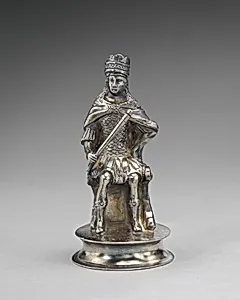
Medium
Silver on base metal
Dimensions
Height: 2 3/4 in. (7 cm)
Classification
Chess Sets-Reproductions|Metalwork-Electrotype
Culture
British, Birmingham, after German original
Department
European Sculpture and Decorative Arts
Museum
Metropolitan Museum of Art, New York, NY
Credit
Gift of Henry G. Marquand, 1883
Accession Number
83.18.48
Rights
Public Domain
Art Historical Context
Step into the intricate world of 19th-century metalwork with *Chessman (King)*, a exquisite reproduction crafted by the pioneering British firm Elkington & Co. in during the third quarter of the19th century (circa 1850–1875). Standing just 2 3/4 inches (7 cm) tall, this silver-on-base-metal piece faithfully copies a 17th-century German original, capturing the regal poise of a chess king in miniature. Housed in the Metropolitan Museum of Art's European and Decorative Arts department, it entered the collection as a gift from Henry G. Marquand in 1883. Elkington & Co. revolutionized manufacturing with electrotyping, a groundbreaking electroplating technique that deposited a thin layer of silver onto a base metal mold. This allowed for precise, affordable replicas of precious historical artifacts, making luxury designs accessible beyond the elite. As part of a chess set reproduction classified under Metalwork-Electrotype, it exemplifies Victorian Britain's passion for Gothic Revival and medieval revivalism, blending artistry with industrial innovation. Chess, with roots in ancient strategy games, held cultural cachet in the 19th century as a symbol of intellect and nobility. This chessman not only preserves a Germanic sculptural tradition but also highlights how electrotypes democratized art collecting, bridging centuries of craftsmanship for modern admirers.
About the Artist
Elkington & Co. · 1829–1963
Elkington & Co. was the Birmingham firm that transformed the production of decorative metalwork by commercializing electroplating — a process that made silver-quality objects accessible to a vastly wider public. The company was established by George Richards Elkington (1801–1865) and his cousin Henry Elkington during the 1830s, initially trading as G. R. Elkington & Co. A crucial turning point cam...