
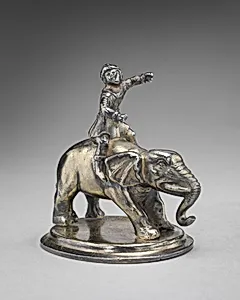
Chessman (Rook)
third quarter 19th century, after 17th century original
Medium
Silver-gilt
Dimensions
Height: 2 1/2 in. (6.4 cm)
Classification
Chess Sets-Reproductions|Metalwork-Electrotype
Culture
British, Birmingham, after German original
Department
European Sculpture and Decorative Arts
Museum
Metropolitan Museum of Art, New York, NY
Credit
Gift of Henry G. Marquand, 1883
Accession Number
83.18.53
Rights
Public Domain
Tags
Art Historical Context
This charming silver-gilt chessman a rook produced by the renowned British firm Elkington & Co. Birmingham during the third quarter the 19th century is a faithful electrotype reproduction of a th-century German original. just 2½ inches tall, it captures the intricate details of historical chess design, where rooks were often depicted as war elephants—powerful symbols of strategy and conquest drawn from medieval European interpretations of Indian chaturanga, chess's ancient ancestor. Elkington & Co. electrotyping, an innovative 19th-century technique using electrolysis to create precise metal copies of precious originals, making fine art accessible beyond elite collectors. Gilded in silver for a luxurious sheen, this piece exemplifies Victorian historicism, blending Renaissance-era motifs—like armored men atop an elephant—with industrial precision. Chess sets like this were prized in gentleman's games and decorative displays, reflecting the era's fascination with medieval chivalry and global cultural exchange. A gift to the Metropolitan Museum of Art from Henry G. Marquand in 1883, this rook invites visitors to ponder the timeless allure of chess: a battlefield shrunk to a tabletop, where elephantine might meets human cunning.
About the Artist
Elkington & Co. · 1829–1963
Elkington & Co. was the Birmingham firm that transformed the production of decorative metalwork by commercializing electroplating — a process that made silver-quality objects accessible to a vastly wider public. The company was established by George Richards Elkington (1801–1865) and his cousin Henry Elkington during the 1830s, initially trading as G. R. Elkington & Co. A crucial turning point cam...