
Chessmen (32)
Unknown Artist
ca. 1750–75
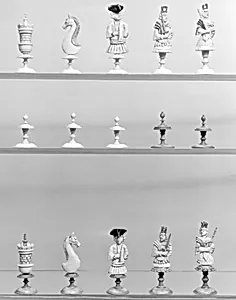
Medium
Bone
Dimensions
Height (each queen): 3 1/8 in. (7.9 cm); Height (each pawn): 1 3/8 in. (3.5 cm)
Classification
Chess Sets
Culture
French, Dieppe
Department
European Sculpture and Decorative Arts
Museum
Metropolitan Museum of Art, New York, NY
Credit
Gift of Gustavus A. Pfeiffer, 1948
Accession Number
48.174.148a–p, aa–pp
Rights
Public Domain
Tags
Art Historical Context
These delicate bone chessmen, crafted in Dieppe, France, around1750–75, represent the pinnacle of 18th-century ivory carving traditions from this coastal town, renowned for its skilled artisans who specialized in small-scale sculptures. Comprising 32 pieces—including queens standing at 3 1/8 inches (7.9 cm) and pawns at 1 3/8 inches (3.5 cm)—this exemplifies the precision and whimsy of Dieppe's workshops. Carvers there transformed humble bone (often from cattle or whale) into intricate game pieces, capturing royal figures with flowing robes, detailed crowns, and expressive faces through meticulous lathe work and hand-finishing techniques. Dieppe chess sets like these were prized across Europe for their affordability compared to ivory counterparts, yet they rivaled fine art in craftsmanship. Chess, a game of intellect beloved by nobility and intellectuals alike, symbolized strategy and leisure in Enlightenment-era salons. These pieces likely served both practical play and decorative display, blending utility with artistry. A generous gift to the Metropolitan Museum of Art from Gustavus A. Pfeiffer in 1948, this set invites visitors to appreciate the anonymous genius of Dieppe's carvers, whose work bridged everyday amusement and sculptural mastery.