
Chessmen (32)
Unknown Artist
19th century
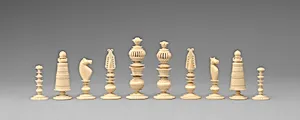
Medium
Ivory
Dimensions
Height (each king): 3 7/8 in. (9.8 cm); Height (each pawn): 2 in. (5.1 cm)
Classification
Chess Sets
Culture
Indian
Department
European Sculpture and Decorative Arts
Museum
Metropolitan Museum of Art, New York, NY
Credit
Gift of Gustavus A. Pfeiffer, 1948
Accession Number
48.174.156a–p, aa–pp
Rights
Public Domain
Tags
Art Historical Context
These exquisite ivory chessmen, comprising a complete set of 32 pieces hail from 19th-century India and showcase the region's masterful tradition of miniature carving. Crafted from ivory—a prized medium valued for its smooth texture and ability to capture fine details—the kings stand at 3 7/8 inches (9.8 cm) tall, while pawns measure 2 inches (5.1 cm), making the set compact and portable, ideal for travel or leisurely play among elites. Donated to the Metropolitan Museum of Art 1948 by Gustavus A. Pfeiffer, now reside in the European Sculpture and Decorative Arts department, highlighting the global exchange of luxury goods during the colonial era. Chess, or chaturanga in its ancient Indian origins, evolved from these cultural heartlands around the 6th century, symbolizing strategy and royal pastime. This set reflects India's enduring ivory craftsmanship, likely influenced by Mughal courtly arts, where artisans transformed elephant tusks into intricate sculptures. Though the artist remains unknown, the pieces embody technical virtuosity: delicate lathe work and precise proportions that balance functionality with aesthetic elegance. For visitors, these chessmen offer a tactile glimpse into Indo-European cultural intersections, inviting reflection on how games transcend borders. Handle with care—their fragility underscores ivory's historical allure and ethical complexities today.