
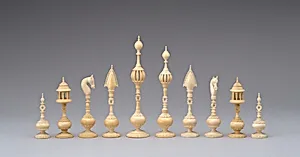
Chessmen (32)
Unknown Artist
18th–19th century
Medium
Ivory
Dimensions
Height (each king): 6 3/4 in. (17.1 cm); Height (each queen): 6 1/16 in. (15.4 cm); Height (each bishop): 4 7/8 in. (12.4 cm); Height (each knight): 4 3/16 in. (10.6 cm); Height (each rook): 4 in. (10.2 cm); Height (each pawn): 3 in. (7.6 cm)
Classification
Chess Sets
Culture
Indian
Department
European Sculpture and Decorative Arts
Museum
Metropolitan Museum of Art, New York, NY
Credit
Gift of Gustavus A. Pfeiffer, 1948
Accession Number
48.174.37a–p, aa–pp
Rights
Public Domain
Tags
Art Historical Context
This exquisite set of 32 ivorymen, crafted by an unknown Indian artist in the 18th–19th century, exemplifies the artistry of South Asian carving traditions. Carved from elephant ivory—a prized medium known for its smooth texture and ability to hold fine details—the pieces follow the classic chess hierarchy: kings stand tallest at 6¾ inches (17.1 cm), queens at 6⅛ inches (15.4 cm), down to pawns at 3 inches (7.6 cm). Housed in the Metropolitan Museum of Art's Department of European Sculpture and Decor Arts, this set was a generous gift from Gustavus A. Pfeiffer in 1948. Chess, or chaturanga in its ancient Indian origins, evolved from a strategic war game around the 6th century CE, spreading globally via trade routes. These chessmen reflect India's enduring cultural passion for the game, blending functionality with decorative elegance. The varying heights and likely stylized forms (bishops as elephants, knights as horses in traditional Indian iconography) highlight the sculptor's mastery of proportion and symbolism, making play both tactical and visually captivating. Though the artist's identity remains elusive, the set's survival speaks to the global exchange of luxury goods during the colonial era, bridging Indian craftsmanship with European collecting tastes. A delightful fusion of leisure and art, these pieces invite visitors to ponder strategy across centuries.