
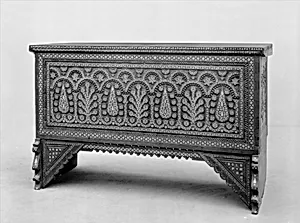
Chest
Unknown Artist
18th century
Medium
Wood, mother-of-pearl; carved, inlaid
Dimensions
H. 35 1/2 in. (90.2 cm) W. 59 in. (149.9 cm) D. 21 5/8 in. (54.9 cm)
Classification
Wood
Department
Islamic Art
Museum
Metropolitan Museum of Art, New York, NY
Credit
Rogers Fund, 1922
Accession Number
22.185.20
Rights
Public Domain
Tags
Art Historical Context
This magnificent 18th-century chest, crafted from wood and adorned with shimmering mother-of-pearllays and intricate carvings, exemplifies the exquisite furniture traditions of Islamic art. Measuring an impressive 35½ inches high, 59 inches wide, and 21⅝ inches deep, it would have served as a prized storage vessel—perhaps for textiles, dowries, or valuables—in a wealthy household. The use of mother-of-pear, a luminous shell material, was a hallmark of luxury craftsmanship in the Islamic world, artisans skillfully cut and inlaid it into wood to create geometric patterns and floral motifs that catch the light beautifully. The techniques of carving and inlay reflect the high level of technical mastery achieved by anonymous workshops during this period, blending functionality with opulent decoration. Such chests were not mere utilities but symbols of status, often produced in regions like the Ottoman Empire, Syria, or North Africa, where Islamic decorative arts flourished. Acquired through the Rogers Fund in 1922 and now housed in the Metropolitan Museum of Art's Department of Islamic Art, this piece invites visitors to appreciate the enduring elegance of these forgotten makers' artistry.