
Lock or Thumbler or Pin
Unknown Artist
16th–19th century
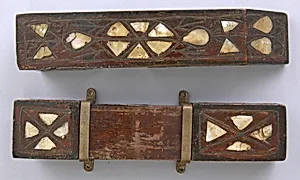
Medium
Wood; carved, inlaid
Dimensions
10.100.170a: Ht. 1 in. (2.5 cm) W. 5 3/8 in. (13.6 cm) D. 7/8 in. (2.3 cm) 10.100.170b: Ht. 1 1/16 in. (2.7 cm) W. 5 3/8 in. (13.7 cm) D. 5/8 in. (1.6 cm)
Classification
Wood
Department
Islamic Art
Museum
Metropolitan Museum of Art, New York, NY
Credit
Rogers Fund, 1910
Accession Number
10.100.170a
Rights
Public Domain
Art Historical Context
This exquisite wooden lock—or possibly a tumbler and pin mechanism—hails from the Islamic world, spanning the 16th to 19th centuries. Crafted wood with intricate carving and inlay techniques, it consists of two small components (cataloged as 10.100.170a and b), each about 1 inch high and5⅜ inches wide. Such modest dimensions belie its ingenuity, suggesting it was part of a portable or architectural lock, blending functionality with artistry in everyday life. In Islamic art, woodwork like this exemplifies the mastery of regional craftsmen, who elevated utilitarian objects through delicate surface decoration. Carving created textured patterns, while inlays—likely of contrasting woods, bone, or ivory—added luminous contrast and geometric motifs emblematic of Islamic design, avoiding figurative representation in favor of rhythmic abstraction. These techniques, honed in workshops from the Ottoman Empire to Persia and beyond, reflect a cultural emphasis on beauty in the domestic sphere, where even security devices became heirlooms. Acquired through the Rogers Fund in 1910, this piece at The Metropolitan Museum of Art invites us to ponder the unseen hands behind Islamic innovation—artisans whose skill secured both doors and legacies across centuries.