
Chief Blanket (Third Phase)
c. 1860/65
Medium
Wool, single interlocking tapestry weave; twined edges; corner tassels
Dimensions
149.6 × 173.9 cm (58 7/8 × 68 1/2 in.)
Classification
textile
Department
Textiles
Museum
Art Institute of Chicago
Accession Number
157115
Rights
Public Domain
About this artwork
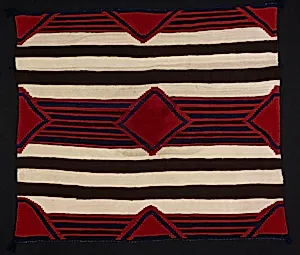
Navajo (Diné) blankets made using fine churro wool and natural dyes are valued as works of special artistic and cultural significance. The design of this blanket, which features a steeped diamond in the center, quarter-diamonds ar each corner, and half-diamonds in the center of each side, was first introduced during the 1860s. The stripes of white, black-brown, and red reflect the continued use of pattern elements typical of earlier blankets. Although such textiles are known as "chiefs' blankets...
Art Historical Context
Welcome to the Textiles gallery, where we spotlight the masterful "Chief Blanket (Third Phase)" woven by Diné (Navajo) artists around 1860–65. This stunning wool textile, measuring nearly 5 by 6 feet, exemplifies the Navajo weaving tradition that flourished in the American Southwest during a time of cultural exchange and trade. Known as "Chief Blankets," these pieces were prized by tribal leaders and Plains Indians for their warmth, durability, and bold designs, often worn as robes or capes. The Third Phase marks a pivotal evolution in Navajo blanket design, featuring intricate stepped motifs, diamonds, and serrated edges in vibrant red, black, white, and blue dyes derived from natural sources. This phase, from the 1850s to 1870s, reflects growing commercial influences as weavers adapted traditional patterns for wider markets, blending indigenous symbolism with market demands. Crafted in a single interlocking tapestry weave—a slitless technique where weft yarns lock around adjacent warps—the blanket showcases exceptional technical skill. Twined edges and corner tassels add structural integrity and decorative flair. Today, at the Art Institute of Chicago, it stands as a testament to Navajo women's artistry, preserving cultural heritage amid historical upheaval like the Long Walk of 1864. (198 words)