
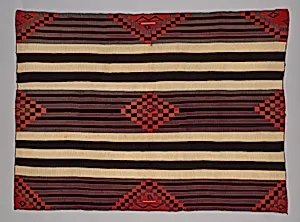
Chief Blanket (Third Phase)
c. 1880
Medium
Wool, plain weave with "lazy lines" and dovetail tapestry weave; warp and weft twining; corner tasseles
Dimensions
153.7 × 206.4 cm (60 1/2 × 81 1/4 in.)
Classification
blanket (covering)
Department
Textiles
Museum
Art Institute of Chicago
Accession Number
210027
Rights
Public Domain
Art Historical Context
This stunning *Chief Blanket (Third)*, woven by Diné (Navajo) around 1880, exemplifies the of Navajo textile traditions in the late 19th century. Measuring an impressive 153.7 × 206.4 cm, this wool blanket served as both a functional covering and a symbol of prestige. Navajo weavers, renowned for their intricate handwoven textiles, produced "Chief Blankets" like this one, which were highly valued trade items, often acquired by Plains Indian leaders—hence the name—despite rarely being worn by Navajo chiefs themselves. The blanket's construction highlights sophisticated techniques: a plain weave accented by "lazy lines" (subtle diagonal shifts from imperfect warp alignment, adding visual texture) and dovetail tapestry weave (where wefts interlock at color changes for seamless patterns). Warp and weft twining strengthens the edges, while corner tassels provide a decorative flourish. These methods reflect the Diné's ingenuity in transforming natural and dyed wool into durable, boldly patterned masterpieces without a loom, using an upright weaving frame. Housed in the Art Institute of Chicago's Textiles Department, this Third Phase example captures a pivotal moment in Navajo weaving evolution, blending traditional motifs with emerging commercial influences. It's a testament to the cultural resilience and artistic innovation of Diné weavers, inviting visitors to appreciate the stories woven into every thread.