
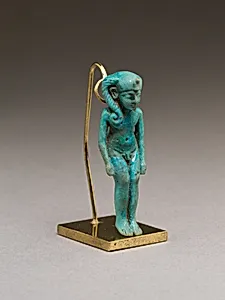
Child god (Harpokrates?) amulet
Unknown Artist
664–30 B.C.
Medium
Faience
Dimensions
H. 5 × W. 1.6 × D. 1.4 cm (1 15/16 × 5/8 × 9/16 in.)
Classification
Amulet, Harpokrates
Period
Late Period–Ptolemaic Period
Department
Egyptian Art
Museum
Metropolitan Museum of Art, New York, NY
Credit
Rogers Fund, 1944
Accession Number
44.4.29
Rights
Public Domain
Tags
Art Historical Context
This delicate faience amulet, depicting child god possibly Harpokrates (the Greek of Horus the Child), hails from Egypt's Late Period to Ptolemaic era (664–30 B.C.). Crafted from glazed quartz-paste ceramic, a material prized for its vibrant turquoise hue evoking the Nile's eternal waters, it measures just 5 cm tall—perfect for wearing as a personal talisman. Faience amulets like this were mass-produced using molds, blending artistry with everyday devotion. Harpokrates, often shown with a finger to his lips in a gesture of silence and secrecy, symbolized protection, especially for children against dangers like scorpions or the evil eye. In ancient Egyptian belief, such figures harnessed divine power to safeguard the wearer in life and the afterlife. These diminutive objects reveal the profound role of magic in daily life, bridging elite temple rituals with common folk practices. Spanning Egypt's waning pharaonic days through Greek Ptolemaic rule, this piece highlights cultural resilience amid foreign influences. Now in the Metropolitan Museum of Art's Egyptian Art collection (Rogers Fund, 1944), it invites us to ponder the tender, protective spirituality of an ancient civilization.