
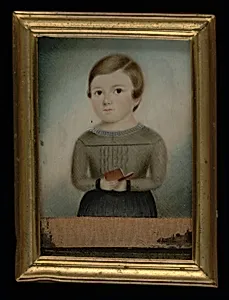
Child Holding a Book
n.d.
Medium
Painting-Miniature
Classification
Painting-Miniature
Department
Smithsonian Collection
Museum
Smithsonian American Art Museum
Credit
Smithsonian American Art Museum, Bequest of Mary Elizabeth Spencer
Accession Number
1999.27.53
Rights
Public Domain
Tags
About this artwork
It is not always possible to identify the sitter in a miniature portrait, and research is still being done on some of the works in the Museum’s collection. Miniatures became popular in England during the early 1700s, commissioned by wealthy families on the occasions of births, engagements, weddings, and bereavements. These paintings, elaborately set into lockets or brooches, provided the wearer with a sentimental connection to a loved one. The back of the miniature often revealed a lock of the s...
Art Historical Context
Behold the delicate charm of *Child Holding a Book*, miniature portrait from the Smithsonian American Art Museum collection, gifted through the bequest of Mary Elizabeth Spencer. This artist's work captures a young sitter in a waist-length view, tenderly cradling a book that evokes innocence, curiosity, and perhaps the promise of education in a bygone era. Like many such miniatures, the identity of this child remains a gentle mystery, with ongoing research inviting us to ponder their story. Miniature paintings flourished in England from the early 1700s, cherished by affluent families to commemorate births, engagements, weddings, or losses. These tiny treasures, often framed in lockets or brooches, offered an intimate, wearable bond to loved ones—a lock of the sitter's hair on the reverse symbolized deep affection or remembrance. The watercolor-on-ivory technique demanded exquisite precision, rendering lifelike details in a format no larger than a thumbnail. The daguerreotype's arrival in 1839 eclipsed miniatures with its affordability and speed, yet they briefly revived around 1900 via the American Society of Miniature Painters. Today, this poignant piece reminds us of portraiture's evolution, blending artistry with heartfelt sentiment in the Smithsonian's treasured holdings.
About the Artist
Unidentified ( ) · –