
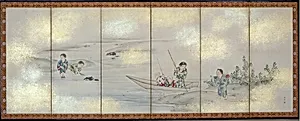
円山応震筆 子供遊び図屏風|Children Playing in Summer and Winter
early 19th century
Medium
Pair of six-panel folding screens; ink, color, and gold on paper
Dimensions
Image (each screen): 32 5/16 in. × 8 ft. 7 3/16 in. (82 × 262.1 cm)
Classification
Paintings
Culture & Period
Japan · Edo period (1615–1868)
Department
Asian Art
Museum
Metropolitan Museum of Art, New York, NY
Credit
Gift of Gitter-Yelen Foundation, 2009
Accession Number
2009.511.1, .2
Rights
Public Domain
Tags
Art Historical Context
This delightful pair of six-panel folding screens, *Children Playing in Summer and Winter*, created by Maruyama shin in the early th century during Japan's Edo period (1615–1868). A follower of the innovative Maruyama school founded by Ōkyo, Ōshin in vivid, realistic depictions of everyday and nature, blending meticulous observation with elegant composition. Crafted with ink, color and gold on paper—a luxurious medium typical of byōbu screens used as room dividers in affluent homes—these works measure an impressive 32 5/16 inches high by over 8 feet wide each, allowing them to envelop viewers in immersive scenes. One screen captures the exuberance of summer, with boys playfully boating amid lush trees and shimmering waters, while the other evokes winter's quiet charm, showing children frolicking in snow-dusted landscapes. The gold-flecked backgrounds add a sense of depth and opulence, a hallmark technique that evokes seasonal transitions and the joy of childhood innocence. Ōshin's precise brushwork highlights the Maruyama style's emphasis on naturalism, departing from idealized ukiyo-e prints to celebrate unpretentious moments. Housed in the Metropolitan Museum of Art's Asian Art Department as a gift from the Gitter-Yelen Foundation in 2009, these screens offer a window into Edo-era prosperity, where genre paintings like this reflected a growing appreciation for leisure and the beauty of ordinary life. They remind us how art captured fleeting joys amid Japan's harmonious blend of tradition and realism.