
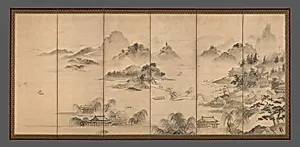
久隅守景筆 西湖図屏風|View of West Lake
mid-to-late 17th century
Medium
Pair of six-panel folding screens; ink and color on paper
Dimensions
.1: 68 3/4 in. × 12 ft. 2 3/8 in. (174.6 × 371.8 cm) .2: 69 in. × 12 ft. 2 3/8 in. (175.3 × 371.8 cm)
Classification
Paintings
Culture & Period
Japan · Edo period (1615–1868)
Department
Asian Art
Museum
Metropolitan Museum of Art, New York, NY
Credit
Purchase, Joseph Pulitzer Bequest, 1972
Accession Number
1972.179.1, .2
Rights
Public Domain
Tags
Art Historical Context
Step into the serene world of Kusumi Morikage's *View of West Lake*, a pair of six-panel folding from Japan's Edo period (mid-to-late 17th century). Crafted ink and color on paper these towering artworks—each over 12 feet wide—immerse viewers in a panoramic vision of China's famed West Lake in Hangzhou, ringed by misty mountains, lush trees, tranquil waters, and scattered houses. Acquired by the Metropolitan Museum of Art in1972, they exemplify the grandeur of *byōbu* screens, prized in Japanese homes and elite gatherings as both functional dividers and stunning backdrops. Morikage, a skilled Edo painter, captures the poetic essence of this iconic site, blending delicate ink washes for atmospheric depth with subtle colors to evoke harmony between nature and human presence. During the Edo era's peace and prosperity, Japanese artists like him drew inspiration from Chinese landscapes, adapting them with a refined, native sensitivity that emphasized seasonal beauty and spatial flow across the unfolding panels. These screens not only showcase masterful composition—guiding the eye from foreground trees to distant peaks—but also reflect cultural exchange across East Asia, inviting us to ponder timeless landscapes that transcend borders. A true treasure of Asian Art!