
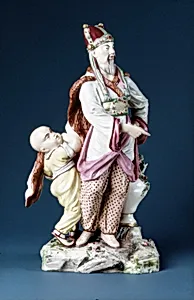
Chinese emperor and attendant
ca. 1765–67 with possible later decoration
Medium
Hard-paste porcelain
Dimensions
Height: 11 1/2 in. (29.2 cm)
Classification
Ceramics-Porcelain
Culture
German, Ludwigsburg
Department
European Sculpture and Decorative Arts
Museum
Metropolitan Museum of Art, New York, NY
Credit
The Jack and Belle Linsky Collection, 1982
Accession Number
1982.60.207
Rights
Public Domain
Tags
Art Historical Context
This delicate hard-paste porcelain figure group, created at the Ludwigsburg Porcelain Manufactory in Germany around 1765–67, captures the era’s widespread fascination with chinoiserie. European courts eagerly collected objects that evoked imagined Asian courts, and Ludwigsburg modelers like Joseph Weinmüller responded with lively, brightly painted figures that blended European porcelain techniques with fanciful “Chinese” costumes and poses. The emperor, accompanied by a youthful attendant, stands just over eleven inches tall, its crisp modeling and glossy glaze showcasing the factory’s mastery of the demanding hard-paste medium. Porcelain production at Ludwigsburg, founded in 1758 under Duke Carl Eugen of Württemberg, formed part of a broader German effort to rival Chinese and Meissen wares. Weinmüller’s sensitive handling of drapery and expression gives the small sculpture a theatrical charm typical of mid-eighteenth-century tableaus designed for aristocratic display. Possible later decoration suggests the piece remained prized long after it left the kiln. Today in the Metropolitan Museum’s European Sculpture and Decorative Arts collection, the figure offers visitors a window into the playful cultural exchange that shaped Rococo taste. Its presence in the Jack and Belle Linsky Collection underscores how such porcelain groups once animated the interiors of Europe’s elite.