
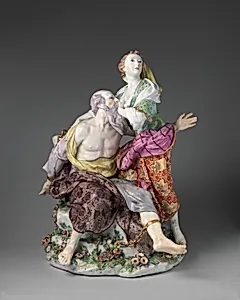
The Roman Charity
ca. 1769
Medium
Soft-paste porcelain
Dimensions
16 1/2 × 13 in. (41.9 × 33 cm)
Classification
Ceramics-Porcelain
Culture
British, Chelsea
Department
European Sculpture and Decorative Arts
Museum
Metropolitan Museum of Art, New York, NY
Credit
Gift of Irwin Untermyer, 1964
Accession Number
64.101.521
Rights
Public Domain
Tags
Art Historical Context
**The Roman Charity** *Chelsea Porcelain Manufactory, ca. 1769* Soft-paste porcelain, ½ × 13 in. (41.9 × 33 cm) Step into the world of 18th-century porcelain with *The Roman Charity*, a delicate soft-paste porcelain group from the renowned Chelsea Porcelain Manuf. This evocative sculpture captures a poignant classical scene inspired by the ancient Roman tale of filial piety: a devoted daughter nursing her imprisoned father, surrounded by elements like flowers that add a touch of naturalistic elegance. The tags—prisoners, men, women, and flowers—highlight its dramatic narrative of human bonds amid captivity, rendered in intricate three-dimensional form. Chelsea, active from the 1740s to around 1770, was a pioneer in British ceramics, mastering soft-paste porcelain—a friable, translucent material made with ground glass (frit) to mimic prized Chinese hard-paste imports. By 1769, during its prestigious "gold anchor" phase, the factory produced luxurious figural groups like this one, showcasing virtuoso modeling, vibrant enameling, and gilding. Donated to the Metropolitan Museum of Art in 1964, it exemplifies the era's neoclassical fascination with virtuous antiquity, blending moral storytelling with opulent decorative arts for elite collectors. This piece not only reflects Chelsea's technical innovation but also the cultural vogue for sentimental history subjects, inviting viewers to ponder enduring themes of loyalty and sacrifice in a fragile, gleaming medium.
About the Artist
Chelsea Porcelain Manufactory · 1744–1784
**Chelsea Porcelain Manufactory** The Chelsea Porcelain Manufactory, Britain's pioneering porcelain enterprise, was founded around 1743 in Chelsea, London, by two Huguenot silversmiths: Nicholas Sprimont from Liège and Charles Gouyn. Sprimont, trained in Paris as a goldsmith before immigrating to England, brought his expertise in luxury metalwork to the venture, while Gouyn handled early sales th...