
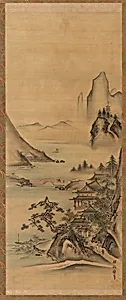
Chinese landscape: summer
18th century
Classification
Painting
Department
Smithsonian Collection
Museum
Smithsonian American Art Museum
Credit
Gift of Charles Lang Freer
Accession Number
F1907.640a-c
Rights
Public Domain
Tags
About this artwork
To 1906-1907
Art Historical Context
Kano Tan'yu (1602–1674), one of the most influential painters of Japan’s Edo period, created this hanging scroll titled *Chinese Landscape: Summer*. A leading figure in the prestigious Kano school, Tan'yu served the Tokugawa shogunate and helped shape official artistic tastes by blending Chinese ink-painting traditions with refined Japanese aesthetics. The work’s evocative title suggests a seasonal scene designed to convey the warmth and vitality of summer through carefully observed natural forms. As a kakemono, or hanging scroll, the painting would have been displayed in a tokonoma alcove during appropriate seasons or special occasions, reflecting the Japanese appreciation for art that harmonizes with the rhythms of nature. The “Chinese landscape” designation points to the enduring influence of continental styles on Edo-period artists, who often looked to Song and Yuan dynasty masters for compositional models while adapting them to local sensibilities. Acquired by Charles Lang Freer and later gifted to the Smithsonian, the scroll forms part of a renowned collection that highlights cross-cultural artistic exchange between East Asia and the United States. Its presence in an American museum today underscores the global reach of Japanese painting traditions that once adorned the castles and temples of the shogunal elite.