
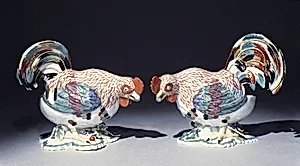
Chinese rooster (one of a pair)
ca. 1732
Medium
Hard-paste porcelain
Dimensions
6 3/8 × 7 1/2 in. (16.2 × 19.1 cm)
Classification
Ceramics-Porcelain
Culture
German, Meissen
Department
European Sculpture and Decorative Arts
Museum
Metropolitan Museum of Art, New York, NY
Credit
Gift of Irwin Untermyer, 1964
Accession Number
64.101.32
Rights
Public Domain
Tags
Art Historical Context
This delightful "Chinese Rooster (one of a)" from the Meissenufactory, crafted around 1732, exemplifies the of European porcelain artistry. Produced in Germany at the pioneering Meissen factory—the first in Europe to master hard-paste porcelain, a durable, translucent material long monopolized by Chinese artisans—this petite sculpture (6 3/8 × 7 1/2 in.) captures a rooster in vibrant, exotic detail. The factory's breakthrough formula, developed under Elector Augustus the Strong, revolutionized decorative arts, allowing intricate modeling and vivid polychrome enameling that rivaled Eastern imports. Rendered in the popular chinoiserie style, the rooster reflects Europe's 18th-century fascination with Chinese aesthetics, blending meticulous European craftsmanship with imagined Oriental motifs. Meissen's animal figures, often modeled by virtuoso sculptors like Johann Joachim Kändler, served as luxurious table ornaments or cabinet displays for the aristocracy, symbolizing status and whimsy. Roosters, evoking vigilance and good fortune, added cultural flair to these conversation pieces. Today, housed in the Metropolitan Museum of Art's European Sculpture and Decorative Arts department (gift of Irwin Untermyer, 1964), this porcelain gem invites visitors to appreciate the fusion of innovation and elegance that defined Rococo-era luxury.
About the Artist
Meissen Manufactory · 1710–present
The Meissen Manufactory, established on June 6, 1710, by Augustus the Strong, Elector of Saxony and King of Poland, marked the dawn of true hard-paste porcelain production in Europe. Nestled at Albrechtsburg Castle in Meissen near Dresden, the Royal Polish and Electoral Saxon Porcelain Manufactory arose from alchemical experiments begun in 1708 by physicist Ehrenfried Walther von Tschirnhaus and p...