
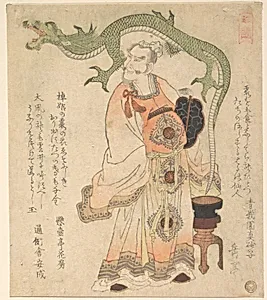
Chinese Sage Evoking a Dragon
ca. 1825
Medium
Woodblock print (surimono); ink and color on paper
Dimensions
8 x 6 15/16 in. (20.3 x 17.6 cm)
Classification
Prints
Culture & Period
Japan · Edo period (1615–1868)
Department
Asian Art
Museum
Metropolitan Museum of Art, New York, NY
Credit
Rogers Fund, 1919
Accession Number
JP1107
Rights
Public Domain
Tags
Art Historical Context
In the vibrant world of Edo-period Japan (1615–8), Yashima Gakutei (active 1810s–1840s), a master of ukiyo-e woodblock prints, created *Chinese Sage Evoking a* around 1825. intimate surimono—a luxurious, privately commissioned print often produced for special occasions like New Year's—measures just 8 x 6 15/16 inches, making it a treasured personal artwork rather than mass-produced fare. Rendered in delicate ink and color on paper, it captures a mythical moment where a wise Chinese sage summons a powerful dragon, blending Confucian sagehood with East Asian folklore where dragons embody imperial might, rain, and cosmic forces. Gakutei's refined style shines through in the print's meticulous composition: flowing robes, ethereal mist, and dynamic dragon scales evoke supernatural energy. Surimono like this often featured embossing, mica flecks, and calligraphy (though specifics here highlight the evocative theme), showcasing advanced woodblock techniques reserved for elite patrons. This piece reflects Japan's fascination with Chinese legends during a time of cultural exchange and artistic innovation, bridging realism and fantasy in ukiyo-e tradition. Acquired through the Rogers Fund in 1919, it's now housed in the Metropolitan Museum of Art's Asian Art Department. Visitors will appreciate how such small-scale wonders packed grand narratives, inviting contemplation of humanity's harmony with the divine.
About the Artist
Yashima Gakutei · 1786–1868
Yashima Gakutei (c. 1786–1868), born in Osaka as the illegitimate son of a Tokugawa shogunate samurai named Hirata, adopted the name from his mother's subsequent marriage into the Yashima clan. Little is documented about his early years beyond these familial ties, but he pursued artistic training under the esteemed ukiyo-e masters Totoya Hokkei and Katsushika Hokusai, absorbing their precision in ...