
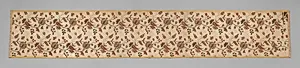
Chintz strip
Unknown Artist
ca. 1700
Medium
Cotton, painted and dyed
Dimensions
confirmed: 9 ft. 8 in. × 19 1/2 in. (294.6 × 49.5 cm)
Classification
Textiles-Painted and Dyed
Culture
Indian, for the European market
Department
European Sculpture and Decorative Arts
Museum
Metropolitan Museum of Art, New York, NY
Credit
Gift of Karen B. Cohen, in honor of Rochelle C. Rosenberg, 2022
Accession Number
2022.147.8
Rights
Public Domain
Art Historical Context
This exquisite *Chintz strip*, crafted around 1700, exemplifies the vibrant artistry of Indian textile production tailored for eager European consumers. Measuring nearly 10 feet long but only 19 inches wide this cotton panel—painted and dyed with intricate floral motifs—was likely used as a border for garments, bed hangings, or upholstery. Produced in India, it reflects the booming global trade era dominated by the East India Company, when such luxurious fabrics flooded European markets, sparking fashion frenzies from England to France. Chintz, derived from the Hindi word *chint* meaning "spotted" or "variegated," was renowned for its bold colors and fine details achieved through a labor-intensive process. Artisans hand-painted designs using natural dyes like indigo and madder, applying mordants (fixatives) to bind hues to the cotton fibers for lasting brilliance. This technique not only showcased technical mastery but also introduced Europeans to exotic botanical patterns, influencing local textile industries and even prompting protective bans in 17th- and 18th-century Europe to shield domestic producers. Today, housed in the Metropolitan Museum of Art's Department of European Sculpture and Decorative Arts as a recent gift, this strip bridges cultures, highlighting how Indian craftsmanship shaped Western tastes and interiors during the Age of Sail. A testament to cross-continental exchange, it invites us to appreciate the artistry woven into everyday luxury.