
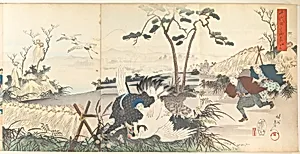
Chiyoda Castle (Album of Men)
Medium
Triptych of woodblock prints; ink and color on paper
Dimensions
L. (page) 13 7/8 in. (35.2 cm); W. (page) 9 1/4 in. (23.4 cm); thickness of album 1 9/16 in. (4 cm)
Classification
Prints
Culture & Period
Japan · Meiji period (1868–1912)
Department
Asian Art
Museum
Metropolitan Museum of Art, New York, NY
Credit
Gift of Mrs. W. Walton Butterworth, 1979
Accession Number
JP3568
Rights
Public Domain
Tags
Art Historical Context
Created in 1897 during Japan’s Meiji period, *Chiyoda Castle (Album of Men)* captures a moment of transition when traditional culture met rapid modernization. Artist Yōshū Chikanobu, a leading ukiyo-e printmaker, specialized in historical and genre scenes that evoked the elegance of earlier eras. The title references Chiyoda, the historic name for Edo Castle, suggesting a nostalgic portrayal of samurai-era life amid the new imperial age. This triptych of woodblock prints—inked and colored on paper—demonstrates the refined technique of late ukiyo-e. Three separate sheets join to form an expansive landscape of trees, birds, and male figures, allowing Chikanobu to unfold a sweeping outdoor vista that single-sheet prints could not achieve. The album format further indicates these images were meant for private viewing and repeated enjoyment rather than public display. As a gift to the Metropolitan Museum, the work preserves a vivid record of Meiji-era artistic response to change, blending meticulous craftsmanship with themes of heritage and nature.
About the Artist
Yōshū (Hashimoto) Chikanobu · 1838–1912
Toyohara Chikanobu, born Hashimoto Naoyoshi in 1838 in Echigo Province (modern Niigata Prefecture), emerged as one of the last great ukiyo-e masters during Japan's Meiji era. The son of a low-ranking samurai retainer to the Sakakibara clan, he trained initially in the Kanō school of painting before turning to ukiyo-e printmaking. He studied under a disciple of Keisai Eisen, then joined the studio ...