
Chiyoda Castle (Album of Men)
Medium
Triptych of woodblock prints; ink and color on paper
Dimensions
L. (page) 13 7/8 in. (35.2 cm); W. (page) 9 1/4 in. (23.4 cm); thickness of album 1 9/16 in. (4 cm)
Classification
Prints
Culture & Period
Japan · Meiji period (1868–1912)
Department
Asian Art
Museum
Metropolitan Museum of Art, New York, NY
Credit
Gift of Mrs. W. Walton Butterworth, 1979
Accession Number
JP3577
Rights
Public Domain
Tags
Art Historical Context
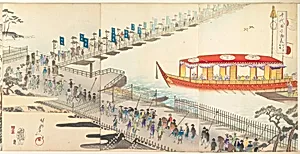
Welcome to the Metropolitan Museum of Art's Asian Art collection, where Yōshū (Hash) Chikanobu's *Chiyoda Castle ( of Men)* (1897) captivates with its vibrant Meiji-era energy. This triptych of woodblock prints, crafted in ink and color on paper, part of an intimate album format—measuring about 14 by 9 inches per page—that invites close viewing. Chikanobu, a master of uki-e ("pictures of the floating world"), specialized in dynamic historical scenes, blending traditional Japanese printmaking with the era's modern influences during Japan's rapid Westernization (1868–1912). The artwork bursts with life at Chiyoda Castle (the former Edo Castle, heart of samurai power), depicting a bustling crowd amid docks, boats, and horses. These elements evoke the organized chaos of feudal processions or daily life, showcasing Chikanobu's skill in composing panoramic narratives across three sheets. Woodblock triptychs like this allowed for expansive storytelling, with intricate carving and hand-rubbed colors capturing textures from rippling water to flowing robes. A gift to the Met in 1979, this piece highlights ukiyo-e's cultural endurance amid Meiji change, preserving Japan's warrior heritage for posterity. It's a window into a world of disciplined men—samurai, retainers, perhaps—reminding us how art bridged old traditions and new horizons.
About the Artist
Yōshū (Hashimoto) Chikanobu · 1838–1912
Toyohara Chikanobu, born Hashimoto Naoyoshi in 1838 in Echigo Province (modern Niigata Prefecture), emerged as one of the last great ukiyo-e masters during Japan's Meiji era. The son of a low-ranking samurai retainer to the Sakakibara clan, he trained initially in the Kanō school of painting before turning to ukiyo-e printmaking. He studied under a disciple of Keisai Eisen, then joined the studio ...