
Chiyoda Castle (Album of Men)
Medium
Triptych of woodblock prints; ink and color on paper
Dimensions
L. (page) 13 7/8 in. (35.2 cm); W. (page) 9 1/4 in. (23.4 cm); thickness of album 1 9/16 in. (4 cm)
Classification
Prints
Culture & Period
Japan · Meiji period (1868–1912)
Department
Asian Art
Museum
Metropolitan Museum of Art, New York, NY
Credit
Gift of Mrs. W. Walton Butterworth, 1979
Accession Number
JP3585
Rights
Public Domain
Tags
Art Historical Context
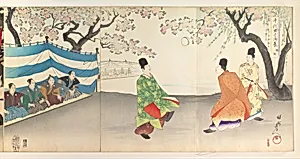
Yōshū Chikanobu’s 1897 triptych *Chiyoda Castle (Album of Men)* offers a vivid glimpse into Japan’s Meiji period (1868–1912), when traditional arts met rapid modernization. Created as part of a paired “Album of Men”, the print set depicts male figures amid the wooded grounds of Chiyoda Castle—now the site of Tokyo’s Imperial Palace—evoking the site’s long history as both fortress and seat of power. Printed as three joined woodblock sheets with ink and color on paper, the work demonstrates the enduring vitality of ukiyo-e techniques even late in the nineteenth century. Chikanobu, renowned for his crisp lines and rich palettes, composed the panoramic format to guide the viewer’s eye across the castle’s natural surroundings, blending portraiture with landscape in a single, harmonious scene. Acquired by the Metropolitan Museum of Art in 1979, this album page preserves a moment when artists looked back to Edo-era subjects while embracing new audiences. The presence of trees and figures underscores themes of seasonal beauty and masculine presence within a historically significant landscape.
About the Artist
Yōshū (Hashimoto) Chikanobu · 1838–1912
Toyohara Chikanobu, born Hashimoto Naoyoshi in 1838 in Echigo Province (modern Niigata Prefecture), emerged as one of the last great ukiyo-e masters during Japan's Meiji era. The son of a low-ranking samurai retainer to the Sakakibara clan, he trained initially in the Kanō school of painting before turning to ukiyo-e printmaking. He studied under a disciple of Keisai Eisen, then joined the studio ...