
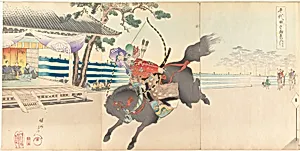
Chiyoda Castle (Album of Men)
Medium
Triptych of woodblock prints; ink and color on paper
Dimensions
L. (page) 13 7/8 in. (35.2 cm); W. (page) 9 1/4 in. (23.4 cm); thickness of album 1 9/16 in. (4 cm)
Classification
Prints
Culture & Period
Japan · Meiji period (1868–1912)
Department
Asian Art
Museum
Metropolitan Museum of Art, New York, NY
Credit
Gift of Mrs. W. Walton Butterworth, 1979
Accession Number
JP3588
Rights
Public Domain
Tags
Art Historical Context
**Chiyoda Castle ( of Men)**, created in 1897 by the prolific ukiyo-e master Yōshū (Hashimoto) Chikanobu captures the dynamic spirit of Japan's Meiji period (1868–1912). This triptych of woodblock prints, rendered in vibrant ink and color on paper forms part of an album measuring about 14 inches long per page. Chikanobu, renowned for his historical scenes and warrior imagery, depicts male figures amid the grand setting of Chiyoda Castleonce Edo Castle, the heart of imperial power in Tokyo. Tags evoke archery, horses, trees, and men in action, suggesting a vivid portrayal of samurai or retainers, blending tradition with the era's modernization. Woodblock triptychs like this were a hallmark of ukiyo-e, allowing panoramic narratives through precise carving and multi-block printing for rich colors and fine details. During Meiji, as Japan opened to the West, artists like Chikanobu preserved cultural icons, romanticizing feudal valor amid rapid change. This work, gifted to the Metropolitan Museum of Art in 1979, highlights the album format's intimacy, inviting viewers to leaf through pages of masculine prowess. Its cultural resonance lies in evoking nostalgia for the shogun era at Chiyoda, a site of political intrigue. A testament to Chikanobu's skill, it offers museum-goers a window into Japan's artistic bridge between old and new. (198 words)
About the Artist
Yōshū (Hashimoto) Chikanobu · 1838–1912
Toyohara Chikanobu, born Hashimoto Naoyoshi in 1838 in Echigo Province (modern Niigata Prefecture), emerged as one of the last great ukiyo-e masters during Japan's Meiji era. The son of a low-ranking samurai retainer to the Sakakibara clan, he trained initially in the Kanō school of painting before turning to ukiyo-e printmaking. He studied under a disciple of Keisai Eisen, then joined the studio ...