
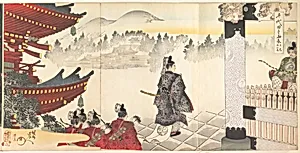
Chiyoda Castle (Album of Men)
Medium
Triptych of woodblock prints; ink and color on paper
Dimensions
L. (page) 13 7/8 in. (35.2 cm); W. (page) 9 1/4 in. (23.4 cm); thickness of album 1 9/16 in. (4 cm)
Classification
Prints
Culture & Period
Japan · Meiji period (1868–1912)
Department
Asian Art
Museum
Metropolitan Museum of Art, New York, NY
Credit
Gift of Mrs. W. Walton Butterworth, 1979
Accession Number
JP3589
Rights
Public Domain
Tags
Art Historical Context
Welcome to the Asian Art galleries, where we encounter *Chiyoda Castle (Album of Men)*, a captivating triptych woodblock print by Yōshū (Hashimoto) Chikan from 1897. This Meiji-period masterpiece, rendered in vibrant ink and color on paper, measures about 14 by 9 inches per page and forms part of an album celebrating masculine pursuits. Chikanobu, a master of ukiyo-e—the "pictures of the floating world"—depicts scenes at Chiyoda Castle (formerly Edo Castle, the shogun's stronghold and now the Imperial Palace), featuring men engaged with bows and arrows amid majestic mountains and trees, evoking the disciplined world of samurai archery. Created during Japan's rapid modernization in the Meiji era (1868–1912), the print bridges tradition and change. As Western influences reshaped society, artists like Chikanobu nostalgically revived warrior themes, preserving cultural icons like Chiyoda Castle through exquisite woodblock techniques. This collaborative process—involving carvers, printers, and publishers—produced the triptych's panoramic format, allowing intricate details in dynamic compositions and rich, layered colors that bring the scene to life. A gift to the Metropolitan Museum of Art in 1979, this work highlights ukiyo-e's enduring appeal, blending historical reverence with artistic innovation for a glimpse into Japan's soul.
About the Artist
Yōshū (Hashimoto) Chikanobu · 1838–1912
Toyohara Chikanobu, born Hashimoto Naoyoshi in 1838 in Echigo Province (modern Niigata Prefecture), emerged as one of the last great ukiyo-e masters during Japan's Meiji era. The son of a low-ranking samurai retainer to the Sakakibara clan, he trained initially in the Kanō school of painting before turning to ukiyo-e printmaking. He studied under a disciple of Keisai Eisen, then joined the studio ...