
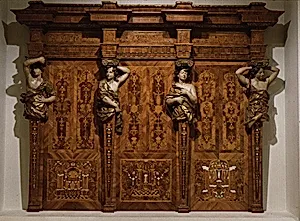
Choir stall panels
ca. 1723–26, figures 1787
Medium
Panel: oak veneered with walnut, boxwod, rosewood, ebony, maple, and other woods, ivory, green-stained horn, and pewter; figures: carved and painted limewood
Dimensions
95-1/2 x 84-1/2 in. (242.6 x 214.6 cm)
Classification
Woodwork-Furniture
Culture
German, Mainz
Department
European Sculpture and Decorative Arts
Museum
Metropolitan Museum of Art, New York, NY
Credit
Gift of Lauritz Melchior, 1951 & 1952
Accession Number
52.120
Rights
Public Domain
Tags
Art Historical Context
In the heart of Baroque Germany, Johann Justus Schacht crafted magnificent choir stall panels around 1723–26 for the Mainz Cathedral, a masterpiece of ecclesiastical woodworking from the Rhineland region. Standing nearly eight feet tall, these panels originally formed part of the ornate seating for clergy during choral services, blending functionality with opulent decoration. The later addition of carved and painted lime figures in 1787 their narrative depth, likely depicting male saints or biblical figures, as suggested by the artwork's tags. Schacht's virtuosity shines in the intricate marquetry technique, where oak panels are veneered with an exotic array of woods—walnut, boxwood, rosewood, ebony, maple, and others—alongside ivory, green-stained horn, and pewter. This labor-intensive process created vivid, illusionistic scenes, showcasing the era's fascination with natural motifs and perspective, hallmarks of German Baroque decorative arts. The use of rare materials underscored the Church's wealth and the craftsman's prestige. Today, these panels, gifted to the Metropolitan Museum of Art by Lauritz Melchior in 1951 and 1952, offer a window into 18th-century Mainz's vibrant workshop culture. They remind us how woodwork bridged sculpture and furniture, elevating sacred spaces with technical brilliance and spiritual symbolism.