
Studiolo from the Ducal Palace in Gubbio
Medium
Walnut, beech, rosewood, oak and fruitwoods in walnut base
Dimensions
H. 15 ft. 10 15/16 in. (485 cm), W. 16 ft. 11 15/16 in. (518 cm), D. 12 ft. 7 3/16 in. (384 cm)
Classification
Woodwork
Culture
Italian, Gubbio
Department
European Sculpture and Decorative Arts
Museum
Metropolitan Museum of Art, New York, NY
Credit
Rogers Fund, 1939
Accession Number
39.153
Rights
Public Domain
Tags
About this artwork
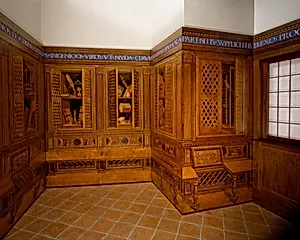
This extraordinary studiolo represents one of the most accomplished achievements of Italian Renaissance intarsia woodwork, commissioned in 1478 by Duke Federico da Montefeltro for his rebuilt palace in Gubbio. Designed by the renowned Sienese artist Francesco di Giorgio Martini, the room was executed under his supervision by the celebrated Florentine brothers Giuliano and Benedetto da Maiano in their workshop before being transported to Gubbio for installation around 1482. The walls showcase the...
Art Historical Context
Step into the intimate world of a Renaissance nobleman with the Studiolo from the Ducal Palace in Gubbio, a jewel of Quattrocento Italian woodwork created around 1478–82. Commissioned by the erudite Duke Federico da Montefeltro for his palace, this paneled room was designed by the visionary Sienese architect Francesco di Giorgio Martini and crafted by Florentine masters Giuliano and Benedetto da Maiano. Measuring nearly 16 feet across, it was meticulously built in their workshop, transported, and installed by 1482, embodying the duke's ideals of scholarship, science, and chivalry. The walls dazzle with intarsia—a virtuoso inlay technique using walnut, beech, rosewood, oak, and fruitwoods—to conjure trompe-l'oeil illusions of open cabinet doors revealing books, measuring instruments, lutes, armor, and even a caged tropical bird. These motifs reflect the Renaissance fascination with perspective, humanism, and exploration, turning a private study into a visual manifesto of the "complete courtier." Acquired by The Metropolitan Museum of Art in 1939 through the Rogers Fund, the studiolo was carefully disassembled, shipped across the Atlantic, and reassembled by 1941. Today, it offers visitors a rare, immersive glimpse into ducal splendor and the boundless ingenuity of Italian Renaissance craftsmanship.
About the Artist
Giuliano da Maiano|Francesco di Giorgio Martini|Francesco di Giorgio Martini|Benedetto da Maiano (Italian|Italian| ) · 1432 |1442 |1438 –1490 |1497 |1478
Italian, Maiano 1432–1490 Naples|Italian, Maiano 1442–1497 Florence|1438–1478