
Chrismatory
Unknown Artist
ca. 1200–1220
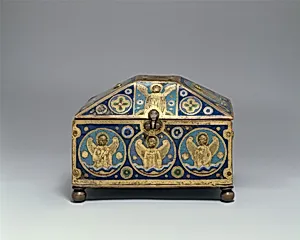
Medium
Copper: engraved, chased, and gilt; champlevé enamel: lapis and lavender blue, turquoise, light and dark green, red, and white
Dimensions
Overall: 3 7/8 x 5 9/16 x 3 3/4 in. (9.9 x 14.2 x 9.6 cm) Overall (without feet): 3 3/8 x 5 9/16 x 3 3/4 in. (8.6 x 14.2 x 9.6 cm)
Classification
Enamels-Champlevé
Culture
French
Department
Medieval Art
Museum
Metropolitan Museum of Art, New York, NY
Credit
Gift of J. Pierpont Morgan, 1917
Accession Number
17.190.853
Rights
Public Domain
Tags
Art Historical Context
This exquisite *Chrismatory*, dating to around 1200–1220, is a rare survivor from medieval France, crafted as a portable vessel to hold the three holy oils—chrism, oil of catechens, and oil of sick—used in Christian sacraments like baptism and anointing. Shaped like a miniature chest with removable compartments, it stands just under 4 inches tall, perfect for a priest's liturgical kit during the High Middle Ages, a time when Gothic art flourished and religious devotion inspired intricate metalwork. Masterfully made from copper that's engraved, chased for textured relief, and gilded for a golden sheen, the piece shines with champlevé enamel—a technique where troughs are carved into the metal, filled with ground glass colors like vibrant lapis blue, turquoise, greens, reds, and whites, then fired to fuse. Angels, likely depicted in the tags, adorn its surfaces, symbolizing divine presence and evoking heavenly realms amid earthly rituals. This method, peaking in 12th-century France, produced luminous, jewel-like effects rivaling stained glass. Housed in the Metropolitan Museum of Art's Medieval Art department (gift of J. Pierpont Morgan, 1917), it highlights the era's technical virtuosity and spiritual fervor, bridging art and faith in everyday worship. A testament to anonymous artisans' skill, it invites us to ponder the sacred oils once glistening within.