
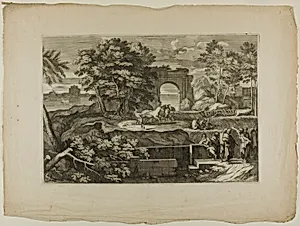
Christ and His Disciples with a Triumphal Arch in the Distance
1668–71
Medium
Etching on ivory laid paper
Dimensions
Plate: 30.3 × 44.2 cm (11 15/16 × 17 7/16 in.); Sheet: 44 × 58.8 cm (17 3/8 × 23 3/16 in.)
Classification
etching
Department
Prints and Drawings
Museum
Art Institute of Chicago
Accession Number
117999
Rights
Public Domain
Art Historical Context
In the late Baroque period, French artist Sébastien Bourdon created *Christ and His Disciples with aphal Arch in the Distance between 1668 and 1671, capturing a poignant biblical moment likely evoking Christ's entry into Jerusalem. Bourdon, renowned for his classical influences from masters like Poussin and his time in Rome, blends spiritual narrative with grand architectural elements. The distant triumphal arch evokes Roman grandeur, symbolizing triumph and eternity, which underscores the scene's messianic themes and reflects the era's fascination with antiquity amid Louis XIV's opulent court culture. This etching on ivory laid paper exemplifies Bourdon's mastery of printmaking, a technique where acid bites into a metal plate to create fine, expressive lines. Measuring 30.3 × 44.2 cm on the plate, it allowed for detailed textures—from the disciples' flowing robes to the arch's intricate stonework—making intricate compositions accessible beyond oil paintings. As one of Bourdon's final works before his death in 1671, it highlights etching's role in disseminating Baroque drama to wider audiences. Housed in the Art Institute of Chicago's Prints and Drawings Department, this piece invites visitors to ponder how 17th-century artists fused faith, history, and technique, bridging sacred stories with classical splendor in an intimate, reproducible format.
About the Artist
Sébastien Bourdon · 1616–1671
Sébastien Bourdon (1616–1671) was a French Baroque painter of remarkable versatility and restless ambition, whose career carried him from the workshops of Paris to the courts of Rome and Stockholm before he returned to France to become a founding member of one of Europe's most important artistic institutions. Born on 2 February 1616 in Montpellier into a Protestant family, Bourdon was apprenticed ...