
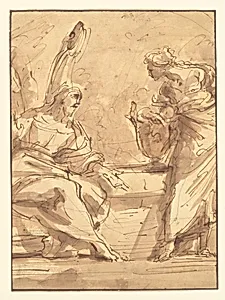
Christ and the Samaritan Woman
1718
Medium
pen and brown ink with brown wash over black chalk on laid paper
Dimensions
sheet: 18.9 × 14 cm (7 7/16 × 5 1/2 in.)
Classification
Drawing
Department
CG-E
Museum
National Gallery of Art, Washington, D.C.
Credit
The Edith Tanenbaum Rudolf Collection
Accession Number
2018.26.23
Rights
Public Domain
Art Historical Context
In the intimate drawing *Christ and the Samaritan Woman (1718), Venetian Baroque master Sebastiano Ricci captures a biblical moment from the Gospel of John, where Jesus converses with a Samaritan woman at the well Created late in Ricci's career, this work reflects the artist's flair for dramatic narratives and fluid figures, hallmarks of Venice's vibrant late-Baroque and emerging Rococo styles. Ricci, a pupil of Sebastiano Mazzoni and influenced by Veronese and Tiepolo, often produced such preparatory sketches to refine compositions for larger paintings, blending spiritual depth with theatrical energy. Executed on a modest laid paper sheet (18.9 × 14 cm), the piece employs black chalk for initial underdrawing, overlaid with precise pen lines in brown ink and subtle brown wash for modeling light and shadow. This mixed-media technique—common in 18th-century Italy—allowed artists like Ricci to explore form, movement, and emotion swiftly, making it a window into the creative process. The compact scale invites close contemplation, highlighting Ricci's mastery of gesture and expression in everyday encounters with the divine. Housed in the National Gallery of Art's Edith Tanenbaum Rudolf Collection (Department CG-E), this drawing exemplifies how Ricci bridged Baroque grandeur with Rococo elegance, offering visitors a glimpse into the artistry behind Venice's golden age of religious painting.
About the Artist
Sebastiano Ricci · 1659–1734
Sebastiano Ricci (1659–1734) was born in Belluno, in the Venetian Republic, and received his early training in Venice, where he was apprenticed at age twelve to the Milanese painter Federico Cervelli. Some accounts identify Sebastiano Mazzoni as his first master. A youthful scandal involving an unintended pregnancy and a charge of attempted poisoning led to imprisonment in 1678, from which he was ...