
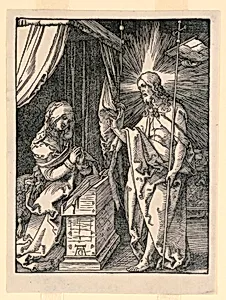
Christ Appearing to His Mother
1509–1511
Classification
figures
Department
Smithsonian Collection
Museum
Smithsonian American Art Museum
Credit
Gift of Leo Wallerstein
Accession Number
1951-170-30
Rights
Public Domain
About this artwork
Research in Progress
Art Historical Context
### Christ Appearing to His MotherAlbrecht Dürer, of the greatest artists of the Northern Renaissance (1471–1528), created *Christ Appearing to His* between 1509 and 1511. This German master revolutionized printmaking and drawing with his extraordinary precision, blending meticulous detail with profound emotional depth. Trained as a goldsmith's son in Nuremberg, Dürer to Italy twice, absorbing Renaissance ideals of proportion and perspective while retaining the intricate line work of Northern Gothic traditions. Works from this mature period, like his *Small Passion* series, showcase his skill in conveying spiritual narratives through human figures—fitting this piece's classification. The artwork depicts a tender moment from Christian scripture: the resurrected Christ revealing himself to the Virgin Mary shortly after the Crucifixion. Such scenes, rooted in medieval devotion, symbolized maternal sorrow turning to joy and the promise of salvation, resonating deeply in early 16th-century Europe amid religious reforms. Dürer's figures likely capture intimate gesture and expressive faces, hallmarks of his ability to humanize the divine. Now in the Smithsonian American Art Museum's Smithsonian Collection (gift of Leo Wallerstein), this piece awaits further research, inviting us to ponder Dürer's enduring influence on Western art. Imagine standing before it, tracing the artist's hand in a vision of resurrection's quiet miracle.