
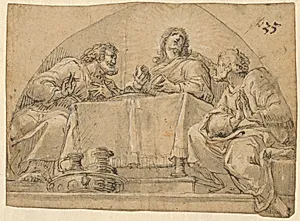
Christ at Emmaus
ca. 1690
Medium
Pen and brown ink, gray wash, heightened with white gouache, on buff paper
Dimensions
Sheet: 5 13/16 × 7 13/16 in. (14.7 × 19.8 cm)
Classification
Drawings
Department
Drawings and Prints
Museum
Metropolitan Museum of Art, New York, NY
Credit
The Elisha Whittelsey Collection, The Elisha Whittelsey Fund, 2014
Accession Number
2014.788
Rights
Public Domain
Tags
Art Historical Context
In the hushed glow of the Metropolitan Museum of Art's Drawings and Prints, Hans Georg Asam'sChrist at Emmaus* (ca. 1690) captures a pivotal biblical moment from the Gospel of Luke. Here, the risen Christ reveals himself to two disciples during a roadside meal, their eyes widening in recognition as he breaks bread. This intimate scene, rendered on buff, exemplifies late Baroque devotional art from southern Germany, where Asam amid the Catholic revival of the Counter-Reformation. Crafted in pen and brown ink with gray wash, heightened by luminous white gouache, the drawing showcases virtuoso techniques of the period. The fluid ink lines define dramatic figures and folds, while washes build depth and shadow, and gouache accents mimic flickering candlelight—common in preparatory sketches for altarpieces or frescoes. At just 5 13/16 × 7 13/16 inches, its small scale invites close contemplation, revealing Asam's mastery of chiaroscuro to evoke spiritual revelation. Acquired through The Elisha Whittelsey Collection in 2014, this work highlights the enduring cultural role of such drawings in 17th-century workshops, bridging ephemeral studies and grand ecclesiastical commissions. A window into Baroque piety, it reminds us how art once kindled faith one stroke at a time.
About the Artist
Hans Georg Asam · 1649–1711
**Hans Georg Asam (1649–1711)** was a prominent German Baroque church painter active primarily in Bavaria and the Upper Palatinate. Born on October 12, 1649, in Rott am Inn as the son of the monastery brewery cook, he trained under his father-in-law, the painter Nikolaus Prugger, whose guidance shaped him into one of the leading ecclesiastical artists of his region. He began as an oil painter but ...