
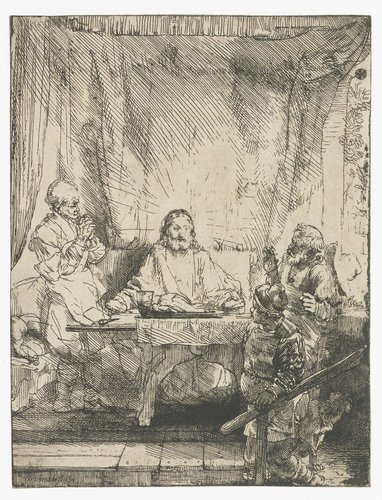
Christ at Emmaus: the larger plate
Medium
etching, printed on Japanese paper
Dimensions
161; 210
Rights
Public Domain
About this artwork
height 210 mm x width 161 mm
Art Historical Context
Rembrandt van Rijn'sChrist at Emmaus: Larger Plate* (1654) captures a pivotal biblical moment from Luke 24: risen Christ revealing himself to two disciples during a meal in Emmaus. Created during the Dutch Golden Age, this etching exemplifies Rembrandt's profound engagement with religious themes, blending spiritual drama with human emotion. At 210 mm high by 161 mm wide, intimate scale invites close contemplation, a hallmark of his late-period works amid personal hardships like financial struggles. Masterfully executed as an etching on luxurious Japanese paper, the print showcases Rembrandt's innovative techniques. He skillfully manipulated light and shadow—chiaroscuro—to illuminate Christ's face and gestures, creating a sense of divine revelation emerging from darkness. The choice of Japanese paper, prized for its absorbency and texture, enhances the ink's richness and fine details, making impressions exceptionally vivid. This "larger plate" version surpasses an earlier, smaller iteration, allowing greater depth in composition and expression. As a cornerstone of Rembrandt's 300+ etchings, it highlights his status as the era's greatest printmaker, influencing generations. For visitors, it offers a window into 17th-century devotion and artistic genius, where faith and technique intertwine.
About the Artist
Rembrandt van Rijn · 1606–1669
Rembrandt Harmenszoon van Rijn (1606–1669) stands as one of the greatest visual artists in the history of Western art and the most important Dutch painter of the 17th century. Born in Leiden to a prosperous miller's family, Rembrandt transformed painting through his revolutionary use of light and shadow, his psychological depth in portraiture, and his elevation of etching to a fine art. His approx...