
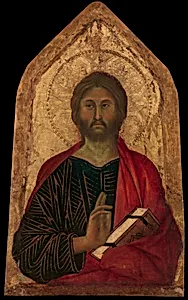
Christ Blessing
ca. 1311
Medium
Tempera on wood, gold ground
Dimensions
Overall, with shaped top, 15 1/2 x 9 1/2 in. (39.4 x 24.1 cm); painted surface 14 x 8 1/8 in. (35.6 x 20.6 cm)
Classification
Paintings
Department
European Paintings
Museum
Metropolitan Museum of Art, New York, NY
Credit
Bequest of Adele L. Lehman, in memory of Arthur Lehman, 1965
Accession Number
65.181.2
Rights
Public Domain
Tags
Art Historical Context
**Christ Blessing**, created around 1311 by the Sienese painter Segna di Buonaventura, the refined elegance of early 14th-century Italian Gothic. This small tempera panel on wood, with its shimmering gold ground, was likely a devotional image for private worship, capturing Christ in a blessing gesture while holding an open book—symbolizing the Gospels. The shaped top and intimate scale (just 15½ x 9½ inches) suggest it may have been part of a portable diptych or a personal altarpiece, inviting contemplation in a medieval household or chapel. Segna, a follower of the masterful Duccio di Buoninsegna, worked in Siena during a golden age of painting that blended Byzantine spirituality with emerging naturalism. The tempera technique—pigments mixed with egg yolk applied in thin glazes over meticulously punched gold leaf—created luminous, jewel-like effects, evoking heavenly radiance. The gold ground, a hallmark of Sienese panels, not only enhanced the sacred aura but also reflected the era's devotion to religious icons amid Italy's burgeoning Renaissance precursors. Today, housed in the Metropolitan Museum of Art thanks to the 1965 bequest of Adele L. Lehman, this gem offers a window into Siena's artistic legacy, where faith and beauty intertwined to inspire profound spiritual connection.