
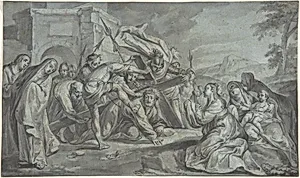
Christ Carrying the Cross
1720–61
Medium
Brush and gray ink, pen and black ink, over graphite on blue paper
Dimensions
6-3/4 x 11-3/8 in. (17.1 x 28.9 cm)
Classification
Drawings
Department
Drawings and Prints
Museum
Metropolitan Museum of Art, New York, NY
Credit
Gift of Katrin Bellinger, in memory of Wolfgang Ratjen, 1998
Accession Number
1998.175
Rights
Public Domain
Tags
Art Historical Context
Johann Wolfgang Baumgartner *Christ Carrying the Cross* (ca. 1720–61) is a poignant drawing capturing a pivotal moment from the Passion of Christ. Rendered on blue prepared paper—a favored ground in 18th-century Europe for its tonal effects—the work measures a modest 6-3/4 x 11-3/8 inches. Baumgartner, an Austrian artist active in the Rococo era, employs graphite underdrawing for initial sketches, precise pen and black ink lines for contours, and subtle brush with gray ink washes to model forms and evoke depth. This mixed-media technique highlights his mastery of light and shadow, common in preparatory studies for larger paintings or frescoes. Created during the Baroque-to-Rococo transition, the drawing reflects the enduring popularity of religious themes in Catholic Europe, particularly in southern Germany and Austria, where Baumgartner worked. The composition likely features Christ burdened by the cross, accompanied by men and women—perhaps Simon of Cyrene or mourning figures—emphasizing human suffering and devotion. Such works served devotional purposes and as models for printmaking or altarpieces. Today, this intimate sheet resides in the Metropolitan Museum of Art’s Drawings and Prints department, a gift from Katrin Bellinger in memory of Wolfgang Ratjen (1998). It offers visitors a window into 18th-century draftsmanship, blending technical virtuosity with spiritual intensity.
About the Artist
Johann Wolfgang Baumgartner · 1712–1761
Comment on works: Religious; Mythology