
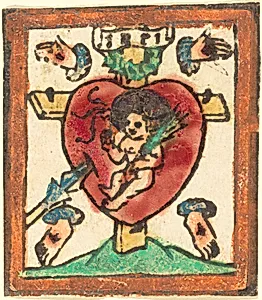
Christ Child in the Sacred Heart
c. 1475/1480
Medium
woodcut, hand-colored in red lake, vermilion, green, blue, yellow, and gold
Classification
Department
CG-E
Museum
National Gallery of Art, Washington, D.C.
Credit
Rosenwald Collection
Accession Number
1943.3.526
Rights
Public Domain
Art Historical Context
This woodcut, created in Germany around 1475–1480, captures a tender devotional image of the Christ Child nestled within the Sacred Heart. during the late medieval period, such prints played a vital role in popular piety, offering affordable yet spiritually powerful images that worshippers could keep at home or carry as aids to prayer. The anonymous artist worked in a time when woodcuts were transforming religious art, making sacred subjects accessible beyond the walls of churches and monasteries. The medium itself highlights both innovation and craftsmanship. Woodcut printing allowed images to be reproduced in multiples from a single carved block, yet each impression was often finished by hand with vibrant colors—here including red lake, vermilion, green, blue, yellow, and gold. These luminous hues would have heightened the emotional resonance of the scene, drawing viewers into its message of divine love and protection. Today, this rare surviving example in the National Gallery of Art’s Rosenwald Collection invites us to appreciate how fifteenth-century printmakers blended technical skill with deep spiritual feeling.
About the Artist
German 15th Century · 1400–1500
**German 15th Century** The designation "German 15th Century" encompasses a collective of anonymous artists active in the late medieval and early Renaissance periods in Germany, primarily known through their contributions to early printmaking and panel painting. These creators emerged during a transformative era when woodcuts and engravings began democratizing religious imagery, bridging the Goth...