
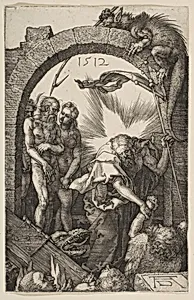
Christ in Limbo, from "The Passion"
1512
Medium
Engraving
Dimensions
Sheet: 4 9/16 × 2 15/16 in. (11.6 × 7.4 cm)
Classification
Prints
Department
Drawings and Prints
Museum
Metropolitan Museum of Art, New York, NY
Credit
Fletcher Fund, 1919
Accession Number
19.73.16
Rights
Public Domain
Tags
Art Historical Context
In the Northern Renaissance masterpiece *Christ in Limbo* (1512), Albrecht Dürer captures a pivotal moment from Christian theology: Christ's descent into the realm of the dead—known as the Harrowing of Hell liberate the righteous souls held there before his resurrection. Part of Dürer's intimate series *The Passion*, a set of 12 small engravings key scenes from Christ's suffering and triumph, this work draws from medieval traditions while showcasing the artist's innovative fusion of German precision and Italian Renaissance humanism. Dürer's mastery of engraving shines in the copper plate's fine, intricate lines, allowing extraordinary detail within the modest sheet size of just 4 9/16 × 2 15/16 inches. Bold male and female nude figures—Adam, Eve, and patriarchs—emerge dynamically from the shadowy abyss, their anatomically precise forms reflecting Dürer's studies of classical art and live models. This technique not only democratized high art through affordable prints but also elevated engraving to rival painting in expressive power. Housed in the Metropolitan Museum of Art's Drawings and Prints department (acquired via the Fletcher Fund in 1919), this piece exemplifies Dürer's role in bridging Gothic spirituality with Renaissance realism, inviting viewers to ponder themes of salvation amid dramatic tension.
About the Artist
Albrecht Dürer · 1471–1528
Albrecht Dürer (1471–1528) stands as the preeminent figure of the Northern Renaissance and arguably the most influential artist in the history of printmaking. Born in Nuremberg on May 21, 1471, and dying in the same city on April 6, 1528, Dürer revolutionized the status of the artist in Northern Europe, transforming printmaking from a commercial craft into an independent fine art and establishing ...