
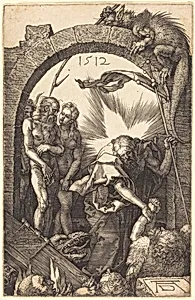
Christ in Limbo
1512
Medium
engraving on laid paper
Dimensions
sheet (trimmed to platemark): 11.6 × 7.5 cm (4 9/16 × 2 15/16 in.)
Classification
Department
CG-E
Museum
National Gallery of Art, Washington, D.C.
Credit
Rosenwald Collection
Accession Number
1943.3.3511
Rights
Public Domain
Art Historical Context
Albrecht Dürer's *Christ in Limbo* (1512) is a masterful engraving on laid paper, measuring just 11.6 × 7.5 cm—small enough to fit in the palm of your hand, yet brimming with intricate detail. Created during the Northern Renaissance, this print captures a pivotal Christian scene: Christ's descent into the realm of the dead (Limbo) to liberate the souls of the righteous, a theme drawn from medieval theology and scripture. Dürer, a German artist renowned for his technical precision and expressive power, elevates this moment of salvation with dramatic contrasts of light and shadow. As one of the greatest printmakers of his era, Dürer pushed the boundaries of engraving, using fine burin lines to achieve unprecedented depth and texture on the metal plate. The laid paper, with its subtle chain lines, enhances the tactile quality of the ink transfer, making each impression a revelation. Produced amid the early stirrings of the Reformation, the work reflects Dürer's fusion of Italian Renaissance humanism with Gothic spirituality, blending anatomical accuracy with symbolic intensity. Housed in the National Gallery of Art's Rosenwald Collection, this trimmed-to-platemark sheet exemplifies Dürer's enduring legacy in democratizing art through affordable prints. Visitors are often struck by how such a tiny image conveys profound theological drama—proof of Dürer's genius in miniaturizing the monumental.
About the Artist
Albrecht Dürer · 1471–1528
Albrecht Dürer (1471–1528) stands as the preeminent figure of the Northern Renaissance and arguably the most influential artist in the history of printmaking. Born in Nuremberg on May 21, 1471, and dying in the same city on April 6, 1528, Dürer revolutionized the status of the artist in Northern Europe, transforming printmaking from a commercial craft into an independent fine art and establishing ...