
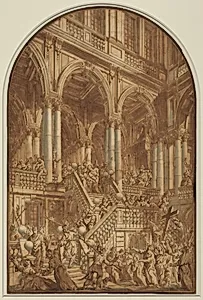
Christ Led Captive from a Palace
1740/1745
Medium
pen and brown ink, brown and gray wash (for architecture), pen and black ink (foreground), pen and gray ink (background), both with brown wash (for the figures)
Dimensions
overall: 60.8 x 40 cm (23 15/16 x 15 3/4 in.)
Classification
Drawing
Department
CG-E
Museum
National Gallery of Art, Washington, D.C.
Credit
Woodner Collection, Gift of Andrea Woodner
Accession Number
2006.11.6
Rights
Public Domain
Art Historical Context
Giuseppe Galli Bibiena’s *Christ Led Captive from a Palace* captures a dramatic moment from the Passion narrative in an imposing architectural setting. Created between 1740 and 1745, the drawing portrays Christ being led away under guard from a grand palace, blending religious storytelling with the artist’s signature interest in monumental spaces. At roughly 61 by 40 centimeters, the sheet invites close viewing of its intricate details while conveying a sense of theatrical scale. Bibiena employs a sophisticated mix of inks and washes to build depth and atmosphere. Brown and gray washes define the soaring columns and arches of the palace, while black and gray inks distinguish the foreground figures from the more delicate background architecture. This layered technique allows the eye to travel from the crowded human drama in the lower half of the composition to the vast, receding halls above, demonstrating the artist’s mastery of perspective and light. Now part of the National Gallery of Art’s collection through the generous Woodner gift, the drawing offers modern viewers a window into eighteenth-century European approaches to religious subjects. Bibiena transforms a solemn biblical event into a visually compelling scene that balances human emotion with the grandeur of imagined architecture.
About the Artist
Giuseppe Galli Bibiena · 1696–1757
Giuseppe Galli Bibiena was born on January 5, 1696, in Parma, into what would become the most celebrated dynasty of theatrical designers in Baroque Europe. He was the second son of Ferdinando Galli Bibiena, who was himself a transformative figure in stage design and the originator of the family's defining innovation: the scena per angolo, or "scene viewed at an angle." This technique replaced the ...