
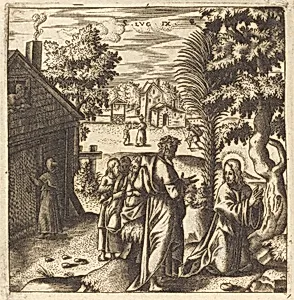
Christ Praying
probably c. 1576/1580
Medium
engraving
Dimensions
sheet: 6.6 × 6.5 cm (2 5/8 × 2 9/16 in.)
Classification
Department
CG-E
Museum
National Gallery of Art, Washington, D.C.
Credit
Rosenwald Collection
Accession Number
1964.8.994
Rights
Public Domain
Art Historical Context
In the late 16th century, French engraver Léonard Gaultier crafted *Christ Praying*, a delicate engraving likely dating to around 1576–1580. Measuring just 6.6 × 6.5 cm, this intimate print captures a moment of profound devotion, portraying Christ in quiet supplication amid the religious fervor of France's Wars of Religion. Gaultier, a master of the Fontainebleau school influenced by Mannerism, produced works that blended Italian elegance with French precision, often reproducing designs by court artists for a growing market of pious collectors. Engraving's meticulous technique—incising fine lines into a copper plate with a burin—allowed Gaultier to achieve intricate details in Christ's expressive face and folded hands, evoking spiritual intimacy. Such small-scale prints were prized for personal meditation, easily carried in prayer books or pockets, reflecting the Counter-Reformation's emphasis on accessible sacred imagery. Housed in the National Gallery of Art's Rosenwald Collection, this piece exemplifies the era's technical innovation and enduring cultural role in fostering faith. Today, *Christ Praying* invites visitors to ponder its quiet power, a testament to how art bridged the divine and the everyday in Renaissance Europe.
About the Artist
Léonard Gaultier · 1561–1641
Léonard Gaultier, a prolific French engraver born in Mainz around 1561, established himself as a prominent printmaker and publisher in Paris, where he died in 1641. Operating from addresses like "A l'Arche de Noé" on rue du Monceau-Saint-Gervais by 1585, he produced book illustrations, frontispieces, title pages, broadsides, almanacs, and standalone prints, often collaborating with publishers such...