
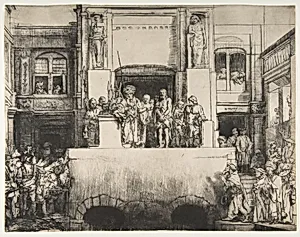
Christ Presented to the People
Medium
Drypoint; eighth state of eight
Dimensions
Sheet: 14 x 17 15/16 in. (35.6 x 45.5 cm)
Classification
Prints
Department
Drawings and Prints
Museum
Metropolitan Museum of Art, New York, NY
Credit
Gift of Felix M. Warburg and his family, 1941
Accession Number
41.1.36
Rights
Public Domain
Tags
Art Historical Context
In the heart of Rembrandt van Rijn's masterful printmaking career, *Christ Presented to the People (1655) captures dramatic biblical moment known as Ecce Homo, where Pontius Pilate presents the bound Christ to a jeering crowd. Created during Rembrandt's mature Baroque period, this drypoint etching exemplifies his profound ability to convey human emotion and spiritual tension through a dense gathering of figures—men pressing forward in a chaotic mass, their faces etched with curiosity, disdain, and fervor. Housed in the Metropolitan Museum of Art's Drawings and Prints department, this generous gift from Felix M. Warburg and his family in 1941 measures 14 x 17 15/16 inches, inviting viewers into an intimate yet monumental scene. Rembrandt's use of drypoint—a direct incising technique that raises a soft burr for velvety, ink-rich lines—lends the eighth and final state unparalleled depth and texture. Unlike smoother etchings, drypoint allowed Rembrandt to build layers of shadow and light, heightening the pathos of Christ's weary expression amid the crowd's turmoil. As one of his late masterpieces, it showcases his innovative print states, where he progressively refined details for emotional impact. This work not only highlights Rembrandt's technical brilliance but also his enduring exploration of faith, suffering, and the human condition, making it a cornerstone of 17th-century European art.
About the Artist
Rembrandt (Rembrandt van Rijn) · 1606–1669
Rembrandt Harmenszoon van Rijn (1606–1669) stands as one of the greatest visual artists in the history of Western art and the most important Dutch painter of the 17th century. Born in Leiden to a prosperous miller's family, Rembrandt transformed painting through his revolutionary use of light and shadow, his psychological depth in portraiture, and his elevation of etching to a fine art. His approx...