
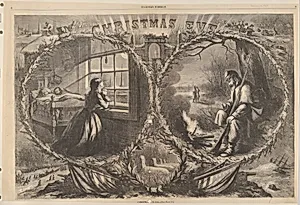
Christmas Eve, 1862 (from "Harper's Weekly," vol. 7, pp. 8-9)
January 3, 1863
Medium
Wood engraving
Dimensions
Sheet: 14 7/16 × 21 7/16 in. (36.7 × 54.4 cm)
Classification
Prints
Department
Drawings and Prints
Museum
Metropolitan Museum of Art, New York, NY
Credit
Harris Brisbane Dick Fund, 1929
Accession Number
29.88.4(8)
Rights
Public Domain
Tags
Art Historical Context
**Christmas Eve, 1862**, a poignant wood engraving by Thomas Nast in *Harper's Weekly* on 3, 1863, captures the emotional weight of the American Civil War the holiday season. Created as a double-page spread (. 7, pp. 8-9), this print from the Metropolitan Museum of Art depicts scenes blending soldiers, families—men, women, boys, and girls the bittersweet spirit of Christmas. Nast, a pioneering political cartoonist, used his platform in the era's leading illustrated newspaper to humanize the war's toll, evoking patriotism and longing amid brutal campaigns like Antietam and Fredericksburg in late 1862. Wood engraving, the medium here (sheet: 14 7/16 × 21 7/16 in.), allowed for intricate detail and rapid mass production, making Nast's work accessible to millions. This technique, involving carving end-grain wood blocks for fine lines, suited *Harper's Weekly*'s vivid reporting style, blending journalism with artistry. The image's timing—just after New Year's—underscored soldiers' sacrifices, fostering national unity and holiday resilience. As a cultural touchstone, Nast's piece reflects how Civil War visuals shaped public sentiment, with his Santa Claus imagery emerging around this time. Acquired via the Harris Brisbane Dick Fund in 1929, it remains a powerful reminder of wartime humanity in the Met's Prints collection.
About the Artist
Thomas Nast|Harper's Weekly · 1840–1902
Thomas Nast (1840–1902) was the most powerful political cartoonist in American history, an artist whose images shaped public opinion, toppled corrupt politicians, and gave enduring visual form to some of the most cherished symbols of American popular culture. Born in Landau, Germany, he emigrated with his family to New York as a child and received his artistic training at the National Academy of D...