
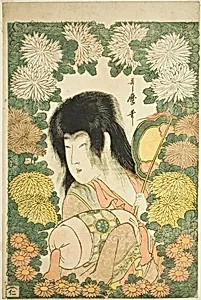
Chrysanthemum Boy
c. 1801/02
Medium
Color woodblock print; aiban
Dimensions
35 × 23.3 cm (13 13/16 × 9 3/16 in.)
Classification
woodblock print
Department
Arts of Asia
Museum
Art Institute of Chicago
Accession Number
110742
Rights
Public Domain
Art Historical Context
**Chrysanthemum Boy created by the renowned Japanese artist Kitagawa Utamaro 1801–02, is a captivating color woodblock print in the aiban format, measuring 35 × 23.3 cm. Housed in the Art Institute of Chicago's Arts Asia department, this work exemplifies the ukiyo-e tradition—"pictures of the floating worldthat flourished during Japan's Edo period (1603–1868). Utamaro, a master this genre, is celebrated for his elegant depictions of beauty, often focusing on women, but here he turns his gaze to a youthful male subject adorned with chrysanthemums, symbols of autumn, longevity, and nobility in Japanese culture. Utamaro's artistic prowess shines through the intricate woodblock printing technique, where multiple carved blocks were inked in vibrant colors and precisely overlaid to achieve lifelike textures and subtle gradients. This labor-intensive process allowed for mass production, making art accessible to everyday people beyond the elite. The aiban size, slightly taller than standard ôban prints, offered an intimate scale perfect for personal appreciation, highlighting Utamaro's innovative compositions that emphasized grace, pattern, and emotional nuance. As one of Utamaro's late works—he passed away in 1806—this print reflects the peak of ukiyo-e's golden age, blending everyday life with poetic symbolism. Visitors are invited to admire how it captures fleeting beauty, a core theme of the era, transporting us to the vibrant streets of old Edo.
About the Artist
Kitagawa Utamaro · 1753–1806
Kitagawa Utamaro (c. 1753-1806) was one of the most celebrated masters of ukiyo-e woodblock printing, revolutionizing the art of bijin-ga (pictures of beautiful women) during Japan's Edo period. Born Kitagawa Ichitaro, his early life remains shrouded in mystery, with conflicting accounts placing his birth in Kyoto, Osaka, Yoshiwara in Edo (modern Tokyo), or Kawagoe in Musashi Province. Under the t...