
Chrysanthemums
1881–82
Medium
Oil on canvas
Dimensions
54.8 × 65.8 cm (21 5/8 × 25 7/8 in.); Framed: 75.3 × 86.4 × 10.8 cm (29 5/8 × 34 × 4 1/4 in.)
Classification
painting
Department
Painting and Sculpture of Europe
Museum
Art Institute of Chicago
Accession Number
16617
Rights
Public Domain
About this artwork
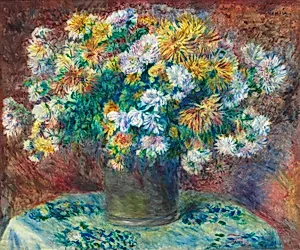
“I just let my brain rest when I paint flowers,” Pierre-Auguste Renoir remarked. “I don’t experience the same tension as I do when confronted by the model. When I am painting flowers, I establish the tones, I study the values carefully without worrying about losing the picture. I don’t dare do this with a figure piece for fear of ruining it.”
Art Historical Context
Pierre-Auguste Renoir'sChrysanthemums* (1881–82), an enchanting oil on canvas measuring 54.8 × 65.8 cm, captures the lush vibrancy of blooming flowers in a classic Impressionist still life. Painted during the height of the Impressionist movement in late 19th-century France, this work showcases Renoir's signature loose brushwork and luminous color palette, designed to evoke the fleeting of natural light on petals and leaves. The intimate scale invites visitors to lean in and savor the textured impasto that brings the chrysanthemums to life, as if freshly cut from a garden. As a leading figure in Impressionism alongside Monet and Pissarro, Renoir often turned to floral subjects to explore sensuous form and atmospheric effects, moving beyond mere representation to convey joy and immediacy. Created just after his pivotal trips to Italy and Algeria, which influenced his evolving style, *Chrysanthemums* reflects his commitment to everyday beauty amid the era's rapid modernization. Housed in the Art Institute of Chicago's Department of Painting and Sculpture of Europe, this piece exemplifies how Renoir transformed ordinary bouquets into celebrations of color and life, offering timeless delight to museumgoers today.
About the Artist
Pierre-Auguste Renoir · 1841–1919
Pierre-Auguste Renoir (1841-1919) was a founding figure of Impressionism whose luminous depictions of Parisian leisure, sensuous female forms, and sun-dappled landscapes made him one of the most beloved painters in Western art history. Born in Limoges to a working-class family, Renoir began as a porcelain painter before pursuing fine arts, and this early craft experience gave him facility with the...