
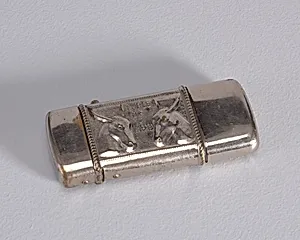
"Chuck Luck Pocket Match Safe and Dice Box"
patented 1893
Medium
containers
Classification
containers
Department
Smithsonian Collection
Museum
Smithsonian American Art Museum
Credit
Gift of Stephen W. Brener and Carol B. Brener
Accession Number
1980-14-17
Rights
Public Domain
About this artwork
Research in Progress
Art Historical Context
Step into the lively world of late 19th-century American pastimes with the "Chuck Luck Pocket Match and Dice Box," patented in 1893. This clever dual-purpose container served gamblers on the go: one side housed matches for lighting cigars or pipes in smoky saloons, while the other dice for Chuck-A-Luck, a popular dice-rolling game of chance akin to roulette. Crafted as a portable "pocket" accessory, it reflects the era's ingenuity in blending utility with discreet entertainment. Patented amid America's Gilded Age gambling boom—fueled by gold rushes, riverboats, and urban vice districts—this object highlights industrial design's rise. Though its maker remains unknown, the match safe's compact form exemplifies mass-producible metalwork, often embossed or enameled for appeal. Chuck-A-Luck, with roots in Chinese games brought by immigrants, captivated players betting on dice outcomes through a caged chute, embodying the thrill and risk of frontier life. Now a treasured gift from collectors Stephen W. Brener and Carol B. Brener in the Smithsonian American Art Museum's collection, this artifact awaits further research. It invites us to ponder how everyday objects captured the spirit of an era defined by innovation, leisure, and a wink at lady luck. (198 words)
About the Artist
Unknown
The artist designated as "Unknown" in our virtual museum's collection exemplifies a poignant chapter in art history: creators whose identities have faded into obscurity despite the enduring power of their work. With only one known artwork attributed to them in our holdings, this figure represents countless anonymous hands that shaped visual culture across centuries. Museums worldwide, including th...