
Churchyard
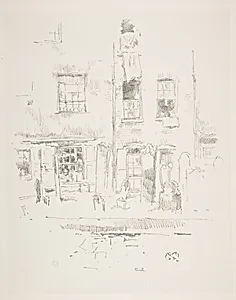
Medium
Transfer lithograph on grayish chine mounted on off-white plate paper; only state (Chicago)
Dimensions
Image: 8 1/4 × 6 13/16 in. (21 × 17.3 cm) Sheet: 15 1/8 × 11 7/16 in. (38.4 × 29 cm)
Classification
Prints
Department
Drawings and Prints
Museum
Metropolitan Museum of Art, New York, NY
Credit
Harris Brisbane Dick Fund, 1917
Accession Number
17.3.169
Rights
Public Domain
Tags
Art Historical Context
James McNeill Whistler’s 1887 transfer lithographChurchyard* captures a quiet burial ground with the artist’s signature sensitivity to atmosphere and tone. Created late in his career, the print reflects Whistler’s deep engagement with lithography, a medium he embraced for its ability to convey delicate textures and subtle gradations of light. The work’s modest scale—roughly eight by seven inches—invites intimate viewing, drawing the eye into the serene, contemplative space of the churchyard. The technique itself is noteworthy: Whistler drew on specially prepared paper that was then transferred to a lithographic stone, allowing for a fluid, almost sketch-like quality while achieving rich tonal effects. Printed in only one state on grayish chine mounted to off-white plate paper, this impression highlights the medium’s capacity for softness and nuance. Now part of the Metropolitan Museum of Art’s collection through the Harris Brisbane Dick Fund, *Churchyard* exemplifies Whistler’s lifelong interest in finding beauty in everyday and somber subjects, inviting viewers to pause and reflect on themes of memory and stillness.
About the Artist
James McNeill Whistler · 1834–1903
James Abbott McNeill Whistler (1834-1903) was an American-born painter and printmaker who became a leading figure in the Aesthetic Movement and pioneer of Tonalism and Japonisme. He revolutionized art by championing "art for art's sake" and treating paintings as visual equivalents of musical compositions, titling works as "arrangements," "harmonies," and "nocturnes" to emphasize formal qualities o...