
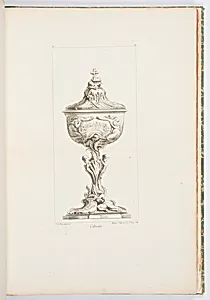
Ciboire (Ciborium), plate 80, from Oeuvres de Juste-Aurèle Meissonnier (Works by Juste-Aurèle Meissonnier)
Classification
metalwork
Department
Smithsonian Collection
Museum
Smithsonian American Art Museum
Credit
Purchased for the Museum by the Advisory Council
Accession Number
1921-6-212-38
Rights
Public Domain
About this artwork
Research in Progress
Art Historical Context
Juste-Aurèle Meissonnier (1695–1750), a French artist born in Italy, was a leading designer of the Rococo period, renowned for his work in goldsmithing, architecture, and ornamental design. This artwork, titled Ciboire (Ciborium) and designated as plate 80 from his collected Oeuvres, presents a design for a ciborium—a covered vessel used in Christian liturgy to contain the Eucharist. Though the specific medium of this piece is unknown, it is classified as metalwork, reflecting Meissonnier's expertise in creating elaborate silver and gold objects. Meissonnier's designs are characterized by the exuberant, asymmetrical forms typical of Rococo, with swirling motifs inspired by nature, shells, and foliage. This ciborium design showcases his innovative approach to liturgical metalwork, blending functionality with ornate decoration that captured the opulence of 18th-century French culture. As part of his published works, this plate would have served to disseminate his influential ideas, inspiring other artisans in decorative arts. The Smithsonian American Art Museum holds this piece, acquired through the Advisory Council. While research is ongoing, it offers a glimpse into the intersection of art, religion, and craftsmanship at the height of the Rococo movement.