
Cigar Store Indian
1935/1942
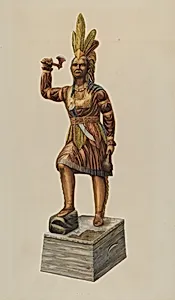
Medium
watercolor, graphite, and pen and ink on paper
Dimensions
overall: 50.4 x 29.2 cm (19 13/16 x 11 1/2 in.)
Classification
Index of American Design
Department
CG-W
Museum
National Gallery of Art, Washington, D.C.
Credit
Index of American Design
Accession Number
1943.8.16390
Rights
Public Domain
Art Historical Context
Step into the vibrant world of American folk art with *Cigar Store Indian* by Einar Heiberg, a captivating 1935/1942 watercolor, graphite, and pen-and-ink rendering on paper (50.4 x 29.2 cm). This detailed depiction captures the iconic wooden statues that once stood sentinel outside tobacco shops across the United States in the 19th and early 20th centuries. These larger-than-life figures, often carved to represent Native Americans, symbolized the plant's indigenous origins and served as eye-catching trade signs in an era before widespread advertising. Created as part of the Index of American Design—a Federal Art Project under the Works Progress Administration during the Great Depression—Heiberg's work preserves a slice of everyday American material culture. Launched in 1935 and spanning until 1942, the Index employed artists to document folk crafts through precise, colorful studies, safeguarding traditions amid economic hardship. Heiberg masterfully blends watercolor's luminous hues for the figure's bold patterns and feathers with graphite's subtle shading and pen-and-ink's crisp lines for intricate details, elevating a commercial artifact into fine art. Today, housed in the National Gallery of Art's Index of American Design collection, this piece highlights the fusion of commerce, culture, and craftsmanship, reminding us how everyday symbols shaped national identity.
About the Artist
Einar Heiberg · 1893–1964
Einar Heiberg (1893–1964) was an American artist best known for his meticulous documentation of everyday American folk art objects during the Great Depression era. Active primarily in the late 1930s, Heiberg contributed significantly to the Index of American Design, a groundbreaking Federal Art Project under the Works Progress Administration (WPA). This initiative commissioned artists across the U...