
Cither-Viol
Unknown Artist
early 19th century
Medium
Wood and various materials
Dimensions
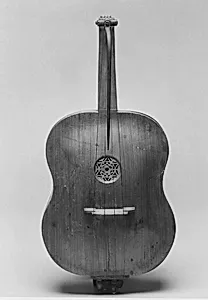
Total length: 41 cm., Neck length: 15.4 cm., Neck width--top/bottom: 2.5/ 3.1 cm., Body length: 26.2 cm. Body width--upper bout/ waist/ lower bout: 19.5/ 17.5/ 21 Body depth--neck/ foot: 3.7/ 4.5 cm. Vibrating length of strings: 32 cm., Diameter of rosette: 4 cm., Bridge height: 3.5 cm.
Classification
Chordophone-Lute-plucked-unfretted
Culture
Spanish
Department
Musical Instruments
Museum
Metropolitan Museum of Art, New York, NY
Credit
The Crosby Brown Collection of Musical Instruments, 1889
Accession Number
89.4.1039
Rights
Public Domain
Art Historical Context
Nestled in the Metropolitan Museum of Art's renowned Crosby Brown Collection of Musical Instruments acquired in 1889 the *Cither-Viol* is a delicate Spanish chordophone from the early 19th century.ed from wood and various materials, this lute without frets measures just 41 cm in total, with a slender neck (15.4 cm long, tapering from 2.5 to 3.1 cm wide) and a compact body (26.2 cm long, widening from 19.5 cm at the upper bout to 21 cm at the lower). Its shallow depth—3.7 cm at the neck joint to 4.5 cm at the foot—highlights the instrument's elegant, portable design, ideal for intimate performances. As a member of the lute family, the *Cither-Viol* features a vibrating string length of 32 cm, a 3.5 cm bridge, and a charming 4 cm rosette soundhole, elements that would have amplified its bright, resonant tones. Unfretted construction allowed skilled players fluid glissandos and expressive phrasing, reflecting Spanish musical traditions blending folk and classical influences during a time of cultural revival post-Napoleonic era. Though by an unknown maker, its precise craftsmanship underscores the artistry of Iberian luthiery, preserving a snapshot of 19th-century soundscapes for today's visitors.