
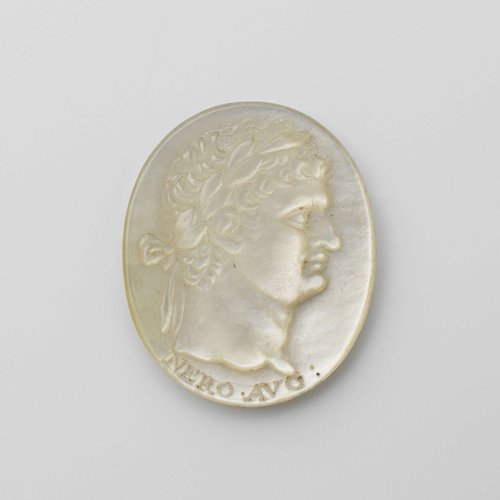
Claudius Drusus Germanicus Caesar (Nero).
ca. 1700 - ca. 1800
Medium
mother of pearl
Dimensions
1.8; 2.2
Rights
Public Domain
About this artwork
height 2.2 cm x width 1.8 cm
Art Historical Context
This exquisite miniature portrait, titled *Claudius Drusus German Caesar (Nero)*, captures the likeness of Nero Claudius Drusus the revered Roman general and stepson of Emperor Augustus (38 BCE–9 BCE). Carved anonymously around 1700–1800, it exemplifies the 18th-century fascination with classical antiquity during the Enlightenment and Grand Tour era, when European collectors prized Roman heroes for their military prowess—Drusus famously led campaigns into Germania, earning the honorific "Germanicus." Crafted from mother-of-pearl (nacre), a luminous medium prized for its iridescent sheen and fine carvability, the piece measures just 2.2 cm high by 1.8 cm wide—small enough for a ring, snuffbox, or pendant. This delicate technique, often associated with cameo or intaglio work, demanded exceptional precision, transforming the shell's natural glow into a lifelike profile that evokes ancient Roman gems while showcasing Baroque-era virtuosity. As a cultural artifact, it reflects how 18th-century artisans revived classical portraiture to celebrate imperial virtue and historical legacy, bridging ancient Rome with modern admiration. A tiny treasure that invites close inspection, it reminds us of art's power to preserve heroism across millennia.
About the Artist
anonymous
In the vast tapestry of art history, "Anonymous" stands not as a singular individual but as a collective designation for countless unidentified creators whose works have endured across millennia. These artists, spanning prehistoric cave painters to medieval illuminators and folk craftsmen, produced the foundational layers of human visual culture. Prior to the Renaissance, when individual fame emer...